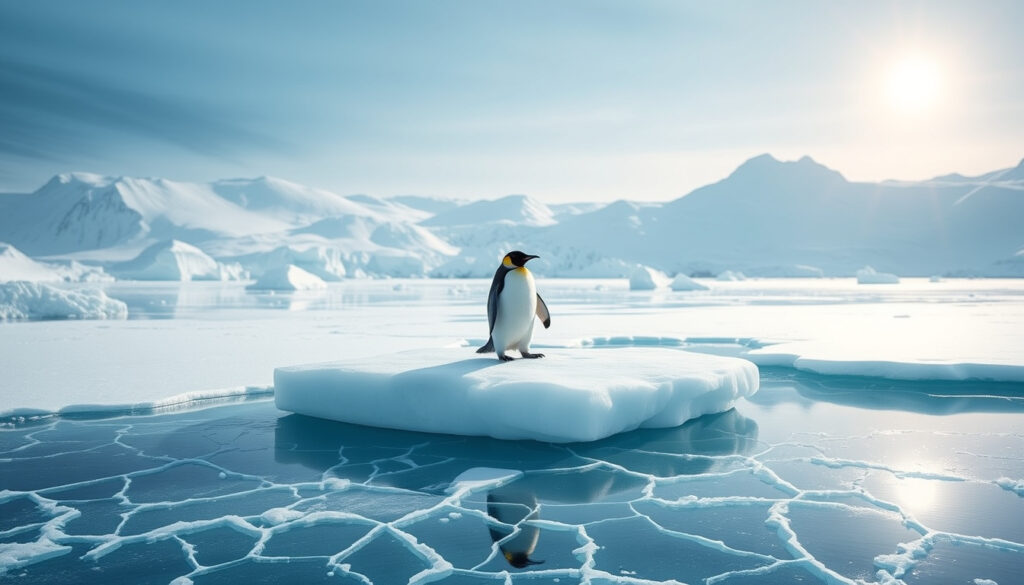
Emperor Penguin: Antarctic Survivor Facing Climate Change
You might not expect any animal to treat the planet’s harshest winter as prime baby-making season. But the emperor penguin has done exactly that for thousands of years — and that extraordinary choice is what makes it both a biological marvel and a climate-change canary.
Height: up to 125 cm (4.1 ft) ·
Weight: 22–45 kg (49–99 lb) ·
Population: ~280,000 breeding pairs ·
Lifespan: 15–20 years in the wild ·
Location: Antarctica (exclusively) ·
Diet: fish, krill, squid
Quick snapshot
- Largest penguin species: up to 125 cm tall (Woods Hole Oceanographic Institution)
- Only bird to breed during Antarctic winter (Australian Antarctic Program)
- Depends on sea ice for breeding, molting, and foraging (Australian Antarctic Program)
- Exact global population: estimates range from 200,000 to 300,000 breeding pairs (Antarctica Environmental Portal)
- Rate of decline under different climate scenarios varies widely (Antarctica Environmental Portal)
- Effectiveness of conservation interventions like marine protected areas remains uncertain (Antarctica Environmental Portal)
- 1844: First described by German naturalist Johann Friedrich von Brandt (Woods Hole Oceanographic Institution)
- 2009: Listed as Near Threatened on IUCN Red List (Woods Hole Oceanographic Institution)
- 2023: US Fish and Wildlife Service proposes Endangered Species Act listing (Woods Hole Oceanographic Institution)
| Attribute | Value |
|---|---|
| Scientific Name | Aptenodytes forsteri |
| Height | 100–125 cm (39–49 in) |
| Weight | 22–45 kg (49–99 lb) |
| Population | ~280,000 breeding pairs |
| Lifespan | 15–20 years (wild) |
| Diet | Fish, krill, squid |
| IUCN Status | Near Threatened |
What is special about emperor penguins?
Largest and heaviest penguin species
- Emperor penguins stand up to 125 cm (4.1 ft) tall and weigh between 22 and 45 kg (Britannica). That makes them the heaviest of all penguins — roughly the size of a human eight-year-old, but much sturdier.
- Their body mass is essential for surviving months without food during incubation.
Breeds during Antarctic winter (darkness, -60°C)
- Emperor penguins are the only birds that breed during the Antarctic winter, enduring temperatures as low as -60°C and months of darkness (Australian Antarctic Program).
- Females lay a single egg in May or June, then transfer it to the male, who incubates it on his feet for about 64 days while the female hunts at sea.
Tuxedo-like plumage and counter-shading
- Their black back, white belly, and yellow ear patches provide camouflage from predators above and below (Animal Diversity Web).
- The yellow-orange patches are unique to the emperor and king penguins.
Unique huddling behavior for warmth
- Thousands of emperor penguins huddle together in tightly packed groups, rotating positions so every bird spends time both in the warm center and on the cold edge (Australian Antarctic Program).
- This cooperative behavior reduces heat loss by up to 50%.
A species that evolved to thrive in extreme cold now faces its biggest threat from warming. The same sea ice that makes winter breeding possible is disappearing — and with it, the foundation of the emperor’s survival strategy.
Which penguin is bigger, king or emperor?
Size comparison: height and weight
- Emperor penguins are larger: up to 125 cm and 22–45 kg, while king penguins max out around 100 cm and 11–16 kg (Antarctic and Southern Ocean Coalition).
- That means emperor penguins can weigh more than twice as much as kings.
Physical differences (coloration, bill shape)
- King penguins have brighter orange patches on the sides of their head and a longer, more slender bill (Antarctic and Southern Ocean Coalition).
- Emperor penguins’ orange patches are more muted, and their bill is shorter and more curved.
Geographic range: emperor in Antarctica, king in sub-Antarctic
- Emperor penguins live exclusively in Antarctica, breeding on sea ice between 66° and 78° south latitude (Animal Diversity Web).
- King penguins breed on subantarctic islands north of 60°S, from the Falklands to Macquarie Island (Antarctic and Southern Ocean Coalition).
Two related species, two very different climates — and two distinct threat trajectories as the planet warms.
Why are emperor penguins going extinct?
Climate change and sea ice loss
- Emperor penguins rely on sea ice for breeding, molting, and feeding. As the Antarctic warms, that ice is breaking up earlier or failing to form (Woods Hole Oceanographic Institution).
- The U.S. Fish and Wildlife Service listed the species as threatened under the Endangered Species Act in 2023, citing ongoing sea-ice decline (Woods Hole Oceanographic Institution).
Declining krill populations
- Krill, a staple food for emperor penguins, is also affected by warming waters and ocean acidification. Industrial krill fishing adds pressure (Antarctic and Southern Ocean Coalition).
IUCN status: Near Threatened to Vulnerable
- The IUCN Red List currently classifies the emperor penguin as Near Threatened, but recent assessments project a shift to Vulnerable as ice loss accelerates (IUCN Red List).
Projected population declines by 2100
- Population modeling suggests that without sharp emissions reductions, emperor penguin numbers could drop by 50–70% by mid-century (Impakter).
- For the Terre Adélie colony, researchers estimate a 36–81% probability of extinction by 2100 (Antarctica Environmental Portal).
If sea-ice continues to shrink at the current rate, emperor penguins may lose their only breeding platform within two generations. The choice is not whether to act — it’s whether we act fast enough.
Are emperor penguins friendly?
Natural wariness vs curiosity
- Emperor penguins have no land predators, so they are less fearful of humans than most birds. They may approach out of curiosity, but they are not aggressive (Animal Diversity Web).
Protected species: no direct contact allowed
- Under the Antarctic Treaty and guidelines from the International Association of Antarctica Tour Operators, visitors must maintain a 5-meter distance from all wildlife (Australian Antarctic Program).
Comparison to other penguin species’ temperament
- Gentoo and Adélie penguins are often more wary and may retreat, while emperor penguins are generally calmer around people.
Can a polar bear ever meet a penguin?
Polar bears live in the Arctic, penguins in the Antarctic
- Polar bears are native to the Arctic (North Pole); emperor penguins are exclusive to Antarctica (South Pole). They have never coexisted naturally (Britannica).
No overlap in natural habitats
- The two species are separated by thousands of kilometers of ocean and opposite hemispheres.
Only in captivity (zoos) could they meet
- In theory, a zoo could house both, but it’s extremely rare due to different climate and diet needs.
Can you name the 18 species of penguins?
Overview of the 18 extant species
- As of 2025, scientists recognize 18 living penguin species, divided into six genera (IUCN Red List).
- Emperor penguins (Aptenodytes forsteri) belong to the genus Aptenodytes, along with king penguins.
Distinct families: Aptenodytes, Pygoscelis, Eudyptes, etc.
- Other groups include the crested penguins (Eudyptes), the brush-tailed penguins (Pygoscelis), and the little penguin (Eudyptula).
Geographic distribution of species
- Most penguin species live in the Southern Hemisphere, from Antarctica to the Galápagos Islands.
Five minutes to impress: Emperor, king, Adélie, chinstrap, gentoo, rockhopper (eastern, western, southern, northern), macaroni, royal, Snares, Fiordland, erect-crested, yellow-eyed, little (blue), African, Humboldt, Magellanic, Galápagos. That’s 18.
The pattern: emperor penguins are built for extreme cold and a longer incubation fast; king penguins evolved for a milder, but still challenging, subantarctic climate.
| Attribute | Emperor Penguin | King Penguin |
|---|---|---|
| Height | 100–125 cm | 80–100 cm |
| Weight | 22–45 kg | 11–16 kg |
| Breeding location | Antarctic sea ice | Subantarctic islands (north of 60°S) |
| Breeding season | Antarctic winter (April–November) | Spring/summer (September–March) |
| Bill shape | Shorter, curved | Longer, slender |
| Ear patch color | Muted yellow-orange | Bright orange |
Confirmed facts vs. what’s unclear
Confirmed facts
- Emperor penguins are the largest penguin species (Woods Hole Oceanographic Institution)
- They breed exclusively in Antarctica during winter (Australian Antarctic Program)
- Sea ice loss is the primary threat to their habitat (Woods Hole Oceanographic Institution)
- They can dive to depths over 500 meters (Britannica)
What’s unclear
- Exact global population number (estimates range from 200,000 to 300,000 breeding pairs) (Antarctica Environmental Portal)
- Rate of decline under different climate scenarios
- Effectiveness of conservation interventions (e.g., marine protected areas)
Expert perspectives
“Emperor penguins are uniquely vulnerable to climate change because their entire life cycle is tied to sea ice. If the ice disappears, so do they.”
— WWF spokesperson, commenting on the species’ reliance on sea ice
“Satellite imagery has been a game-changer for tracking emperor penguin colonies. We can now see exactly where they are and how fast the ice is changing around them.”
— Dr. Michelle LaRue, Antarctic ecologist and satellite monitoring specialist
“The IUCN assessment reflects a growing consensus: without decisive climate action, emperor penguins will edge closer to extinction this century.”
— IUCN Red List evaluation statement
The implication: scientists are no longer debating whether emperor penguins are threatened — they are watching it happen in real time from space.
For the emperor penguin, the consequence is stark. If greenhouse gas emissions continue unabated, Antarctic sea ice will keep shrinking, and the largest penguin species will lose its only breeding ground. The choice for policymakers and the global community is simple: slash emissions, or watch this bird disappear from the wild within the lifetimes of children alive today.
facebook.com, carbonbrief.org, instagram.com, pmc.ncbi.nlm.nih.gov, pnas.org, en.wikipedia.org
Frequently asked questions
Do emperor penguins have feathers?
Yes. Emperor penguins have a dense layer of feathers — up to 100 per square inch — that provides waterproofing and insulation (Animal Diversity Web).
How do emperor penguins keep warm?
They rely on thick blubber, layered feathers, and huddling behavior. Thousands of birds pack together, rotating so each gets a turn in the warm center (Australian Antarctic Program).
What is the scientific name of emperor penguin?
Aptenodytes forsteri (Britannica).
How many eggs do emperor penguins lay?
One egg per breeding season. The male incubates it on his feet for about 64 days while the female forages at sea (Australian Antarctic Program).
How long do emperor penguin chicks stay with parents?
Chicks remain with their parents for about 8–9 months, until they can fledge and hunt on their own (Animal Diversity Web).
Are emperor penguins endangered?
The IUCN lists them as Near Threatened, but the U.S. Fish and Wildlife Service has proposed listing them as threatened under the Endangered Species Act (Woods Hole Oceanographic Institution).
What is a sad fact about penguins?
Many penguin species, including emperors, are losing their habitats due to climate change. Some colonies have already experienced complete breeding failure when sea ice broke up early.
Which penguin is the friendliest?
Among Antarctic species, emperor penguins are often considered the calmest around humans, though all wild penguins should be observed from a respectful distance.
More related posts
 Best ASICS Running Shoes for Women in Ireland 2025
 Indian Food Near Me – Top Naperville Restaurants 2025
 Find My iPhone Login: Sign In and Track Your Device
 Sisters and Seekers Hoodie: Sizes, Styles & Where to Buy
 Yul Brynner: The Bald King, Feuds, and Final Message
 Will Smith and Jada: Marriage Status, Rumors and Facts
 Bear in the Big Blue House – Cast, Episodes, Streaming Guide
 Do a Barrel Roll x200 – Star Fox Google Trick Explained