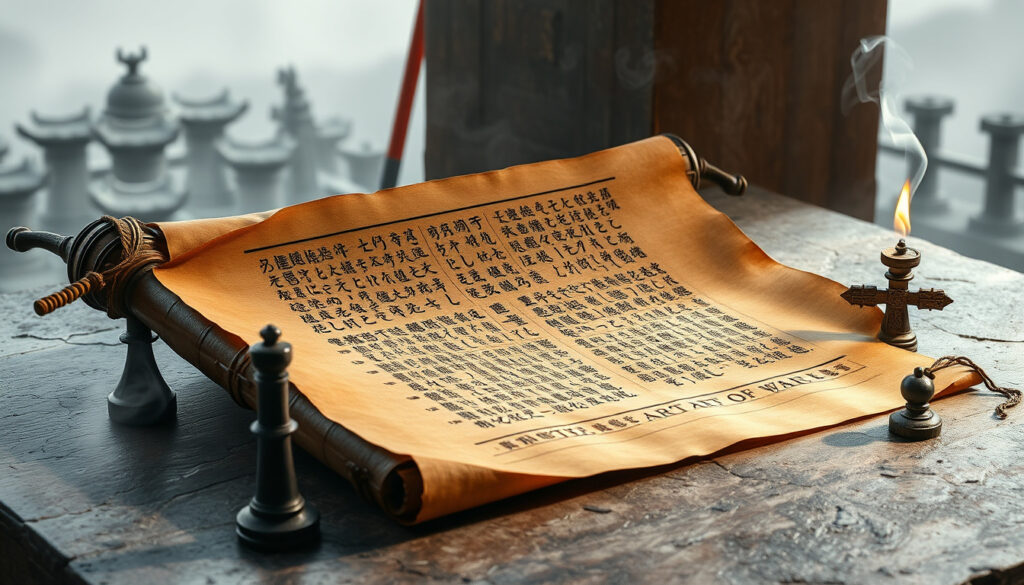
The Art of War: Sun Tzu Summary, Quotes & Principles
Few texts have shaped strategic thinking across continents and centuries quite like Sun Tzu’s treatise. Written over two millennia ago in ancient China, its 13 chapters distill lessons on deception, economy of force, and knowing your enemy that still resonate in boardrooms and battlefields alike. Whether you’re drawn to its famous quotes or its layered philosophy, there’s a reason military leaders from Napoleon to modern executives keep returning to these pages.
Author: Sun Tzu · Era: 5th century BCE · Type: Military treatise · Origin: Ancient China · Chapters: 13
Quick snapshot
- “To subdue the enemy without fighting is the acme of skill” (Goodreads)
- “All warfare is based on deception” (James Clear)
- “Know yourself and know your enemy, and in a hundred battles you will never be in peril” (Goodreads)
- Five Essentials for Victory (when to fight, handling forces, unified spirit, preparedness, military capacity)
- Five Heavenly Factors (Moral Law, Heaven, Earth, Commander, Rules)
- Emphasis on speed, deception, and attacking weakness
- Used by military strategists for over 2,000 years (World History Encyclopedia)
- Studied by Napoleon, Mao Zedong, and modern business leaders (World History Encyclopedia)
- Battle of Boju (506 BCE) demonstrated practical application of principles (World History Encyclopedia)
| Attribute | Value |
|---|---|
| Author | Sun Tzu (Sunzi, Sun Wu) |
| Date | 5th century BCE |
| Period | Late Spring and Autumn |
| Format | Military treatise |
| Chapters | 13 |
| Language | Classical Chinese |
What is the main point of The Art of War?
Sun Tzu opens the treatise with a striking declaration: “The art of war is of vital importance to the State. It a matter of life and death, a road either to safety or to ruin.” This framing establishes the stakes from the outset—the work treats warfare not as an adventure but as a calculated endeavor where a single misstep can doom an entire state.
The central teaching of The Art of War holds that the best strategy wins without direct conflict. Sun Tzu repeatedly emphasizes that subduing the enemy without fighting represents the highest form of skill, making confrontation a last resort rather than a preferred approach.
Core philosophy
The treatise advocates for economy in all aspects of warfare. Sun Tzu argues that war is costly, destructive, and unpredictable—qualities that make avoiding it altogether the mark of true strategic mastery. He writes that a wise leader blends considerations of advantage and disadvantage together, never committing to battle without weighing the full consequences.
Central to Sun Tzu’s philosophy is the principle that leaders should attack where the enemy is weakest and avoid direct engagement where the enemy is strongest. The goal is to make the enemy miscalculate and position forces in wrong places, achieving victory through superior positioning rather than superior firepower.
Key themes
- Deception as foundation: Sun Tzu states that “all warfare is based on deception”—appearing weak when strong, strong when weak, and keeping opponents perpetually off-balance.
- Know yourself, know your enemy: Understanding both one’s own force capabilities and the enemy’s capabilities is essential for victory.
- Emotional control: Sun Tzu identifies anger and greed as fundamental causes of defeat, arguing that the unemotional, calm warrior prevails over the hothead seeking vengeance.
- Speed and economy: Rapidity is the essence of war; prolonged campaigns drain resources and invite disaster.
What are the 5 rules of The Art of War?
Sun Tzu identifies five essentials for victory that encompass the full spectrum of strategic planning and execution. These principles remain relevant across military, business, and diplomatic contexts, offering a framework for decision-making under uncertainty.
Rule breakdowns
- Know when to fight and when not to fight: Discipline in avoiding unnecessary conflict distinguishes the master strategist from the impulsive fighter.
- Know how to handle both superior and inferior forces: Flexibility in commanding forces of varying sizes and capabilities ensures adaptability across different scenarios.
- Have an army animated by the same spirit throughout all ranks: Unity of purpose and morale across all levels of an organization prevents fragmentation and ensures coordinated action.
- Be prepared while the enemy is unprepared: Sun Tzu teaches that good fighters first put themselves beyond the possibility of defeat, then wait for an opportunity—readiness is the foundation of opportunity.
- Have military capacity without sovereign interference: Leaders must have authority to act decisively; excessive bureaucratic control undermines strategic effectiveness.
These five rules interlock with Sun Tzu’s broader teachings on the Five Heavenly Factors: the Moral Law, Heaven (weather conditions), Earth (terrain), Commander, and Rules and Regulations. Together they form a comprehensive framework for assessing any competitive situation.
Sun Tzu’s rules aren’t about aggression—they’re about restraint and calculation. The master strategist knows that every unnecessary engagement carries risk, and the highest skill lies in winning without fighting at all.
What is the most famous line in The Art of War?
Two lines from The Art of War dominate popular quotation: “To subdue the enemy without fighting is the acme of skill” and “All warfare is based on deception.” Both encapsulate Sun Tzu’s core philosophy, though they emphasize different aspects of his strategic vision.
Iconic quotes
“To win one hundred victories in one hundred battles is not the acme of skill. To subdue the enemy without fighting is the acme of skill.”
— Sun Tzu, The Art of War (Goodreads)
“Know yourself and know your enemy, and in a hundred battles you will never be in peril.”
— Sun Tzu (Graham Mann)
“All warfare is based on deception. Hence, when able to attack, we must seem unable; when using our forces, we must seem inactive; when we are near, we must make the enemy believe we are far away; when far away, we must make him believe we are near.”
— Sun Tzu (James Clear)
Context
Sun Tzu’s emphasis on avoiding direct conflict reflects the historical context of ancient Chinese warfare, where campaigns could devastate agricultural economies and destabilize ruling dynasties. By framing victory without battle as the pinnacle of skill, Sun Tzu aligned his recommendations with the practical interests of rulers concerned about resource depletion and political vulnerability.
The quotes also reveal Sun Tzu’s psychological sophistication. He understood that perceptions often matter more than realities in competitive situations—that making an enemy miscalculate can be more valuable than having superior numbers.
These famous lines have transcended their military origins to become reference points in business strategy, sports psychology, and negotiation theory. The appeal lies in their counterintuitive wisdom: strength often comes from avoiding confrontation rather than seeking it.
Why is The Art of War a must read?
The Art of War has been used by military strategists for over 2,000 years, admired by leaders from Napoleon—who reportedly carried it during his campaigns—to Mao Zedong, who integrated its principles into guerrilla warfare doctrine. The treatise’s longevity testifies to its foundational influence on strategic thought across cultures and eras.
Historical impact
Sun Tzu served as military strategist for the State of Wu during the Wu Chu wars (512–506 BCE), and his principles were dramatically demonstrated at the Battle of Boju in 506 BCE, where Wu forces under his command defeated the larger army of Chu through superior tactics and strategic positioning. This victory validated his methods and established his reputation across ancient China.
The treatise spread beyond China’s borders through translation into neighboring cultures and eventually into European languages, where it influenced military academies and strategic thinking from the 18th century onward.
Modern relevance
Contemporary readers encounter The Art of War in contexts far removed from ancient battlefields—business schools teach its principles for competitive strategy, sports coaches reference its insights on psychology, and diplomats apply its teachings on negotiation and deterrence. The universal applicability of Sun Tzu’s framework explains its persistent appeal across disciplines.
The Art of War rewards re-reading. Passages that seem abstract on first encounter reveal practical depth as readers encounter situations where Sun Tzu’s wisdom applies. However, translating ancient principles into modern contexts requires careful interpretation—the framework remains sound, but application demands judgment.
What are the 12 principles of The Art of War?
The Art of War organizes its teachings across 13 chapters, each addressing distinct aspects of warfare and strategy. Rather than a simple numbered list of “principles,” Sun Tzu’s text presents interconnected concepts that work together as a comprehensive strategic system.
Principle list
- Laying Plans: Strategic assessment and political/environmental factors (Sun Tzu identifies five fundamental factors)
- Waging War: Economic considerations, the cost of conflict, and the importance of brevity
- Attack by Stratagem: Deception, negotiation, and the use of indirect approaches
- Tactical Disposition: Positioning forces for maximum advantage
- Energy: Direct and indirect approaches, momentum in campaign execution
- Weak and Strong Points: Identifying vulnerabilities in oneself and the enemy
- Maneuvering: Flexible responses, turning advantages into victories
- Variation of Tactics: Adapting approaches to changing circumstances
- The Army on the March: Movement, logistics, and maintaining readiness
- Terrain: Evaluating the battlefield and using landscape to advantage
- The Nine Situations: Classifying competitive scenarios and appropriate responses
- Attack by Fire: Using the environment, psychological warfare, and irregular tactics
- The Use of Spies: Intelligence gathering and information warfare
These 13 chapters address overlapping themes across different scales—from the political assessment that opens the text to the operational details of specific tactics. The structure reflects Sun Tzu’s integrated approach: no single principle operates in isolation.
Confirmed facts vs. What’s unclear
Confirmed facts
- The Art of War is an ancient Chinese military treatise (Wikipedia)
- Authorship attributed to Sun Tzu (also known as Sunzi or Sun Wu)
- Written during the late Spring and Autumn period, 5th century BCE
- The text comprises 13 chapters covering warfare and strategy
- Used by military strategists for over 2,000 years
- Studied by historical figures including Napoleon and Mao Zedong
What’s unclear
- The exact date of composition (estimates range from 5th century BCE to Warring States period, 481–221 BCE)
- The precise character count in original manuscripts (sources vary on whether it comprises exactly 6,200 Chinese characters)
- The extent to which later editors modified the original text
- How much of Sun Tzu’s methods can be verified against his actual campaigns versus later attributions
Notable passages
“The supreme art of war is to subdue the enemy without fighting. It is the height of generalship to capture the enemy whole through strategic maneuvers.”
— Sun Tzu (SparkNotes)
“No town should be attacked which, if taken, cannot be held, or if left alone, will not cause any trouble.”
— Sun Tzu (Graham Mann)
“Heaven and Earth are necessary components for a ‘complete victory.'”
— Sun Tzu (SparkNotes)
The Art of War remains a touchstone for anyone studying strategy, influence, or competition. Its principles emerged from ancient warfare but translate remarkably well to modern contexts where resources are limited, stakes are high, and the goal is achieving objectives without exhausting oneself in the process.
For modern readers—whether in business, politics, or personal development—Sun Tzu’s central insight holds: the greatest victories often come without confrontation. The skill lies in positioning, timing, and understanding both your own capabilities and those of your opponent.
Related reading: The Lord of the Rings: The War of the Rohirrim – Complete Guide · The Lord of the Rings – The War of the Rohirrim – Complete Guide
supersummary.com, mrartofwar.com, goodreads.com, shortform.com, youtube.com
Frequently asked questions
What is The Art of War?
The Art of War is an ancient Chinese military treatise written by Sun Tzu during the late Spring and Autumn period (roughly 5th century BCE). It consists of 13 chapters covering strategy, tactics, deception, and the economics of warfare, and has influenced military and strategic thinking for over 2,000 years.
Who is Sun Tzu?
Sun Tzu was an ancient Chinese military strategist and philosopher, also known as Sunzi or Sun Wu. He served the State of Wu and is credited with leading Wu forces to victory at the Battle of Boju in 506 BCE. His teachings became foundational for Chinese military doctrine and later spread worldwide.
How long is The Art of War?
The Art of War comprises 13 chapters and was originally written on bamboo strips. The text consists of approximately 6,200 Chinese characters in classical Chinese, making it a relatively compact work that could be memorized or physically carried in ancient times.
Where can I read The Art of War?
The full text is widely available in multiple translations through major publishers, academic libraries, and online repositories. Many translations include scholarly introductions and annotations that provide historical context for understanding Sun Tzu’s principles.
Is The Art of War relevant today?
The Art of War remains highly relevant across military, business, sports, and diplomatic contexts. Its emphasis on strategy over brute force, the importance of intelligence and deception, and the economic realities of extended conflict apply directly to modern competition in various forms.
What are the 13 chapters of The Art of War?
The 13 chapters are: Laying Plans, Waging War, Attack by Stratagem, Tactical Disposition, Energy, Weak and Strong Points, Maneuvering, Variation of Tactics, The Army on the March, Terrain, The Nine Situations, Attack by Fire, and The Use of Spies. Each addresses a distinct aspect of warfare and strategy.
Did Napoleon really study The Art of War?
Napoleon is frequently cited as a student of Sun Tzu’s work, though historical evidence of direct influence is limited. The connection reflects broader recognition that The Art of War had become a foundational text in strategic education by the time of Napoleon’s campaigns, and many of his principles aligned with Sun Tzu’s teachings.
Why is The Art of War so famous?
The Art of War’s fame stems from its combination of practical wisdom, memorable quotations, and universal applicability. Its relatively brief format, clear principles, and counterintuitive insights into strategy and human nature have made it accessible to readers far beyond military contexts.
More related posts
 Cast of Mary Poppins (1964): Ages, Roles, and Where They Are Now
 Barry Keoghan and Sabrina Carpenter: Breakup, Timeline & Cheating Rumors
 Nottingham Forest vs Tottenham Stats: H2H, Results & Predictions
 Emperor Penguin: Antarctic Survivor Facing Climate Change
 White Smoke from Exhaust: Causes, Fixes & Risks
 The Spa at Carden Park Hotel – Facilities, Prices and Booking Guide
 Rosamund Pike: Partner, Children, Movies, Net Worth & More
 What Is the Independent Variable? Definition & Examples