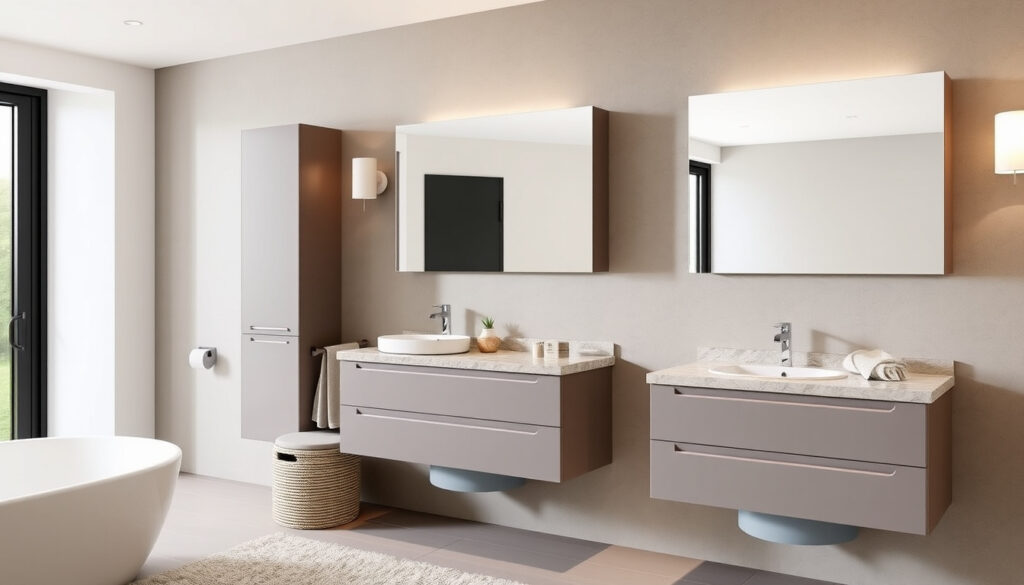
Vanity Unit Guide: Types, Sizes, and Buying Tips for Ireland
Anyone who has ever tried to find a sink that also hides toiletries knows the frustration of a cluttered bathroom. A vanity unit solves that neatly by combining a basin with storage, and in Ireland, where space is often at a premium, choosing the right one can make the difference between a cramped washroom and a functional one.
Standard single vanity width: 600 mm ·
Most common material: MDF with veneer ·
Average price range (Ireland): €250 – €1,200 ·
Popular mounting type: Wall-hung
Quick snapshot
- Standard vanity widths are 600mm, 800mm, 1000mm, 1200mm (Bathroom Warehouse Ireland)
- Wall-hung units require reinforced wall mounting (Big Bathroom Shop Ireland)
- Most vanity units use MDF or plywood core (B&Q Ireland)
- Exact average price due to wide variation across materials and brands
- Specific building regulations for bathroom furniture in Ireland (consult local codes)
- No specific market timeline events identified for this product category
- Measure your space and identify the right width and mounting type
- Compare local Irish suppliers for best price and warranty
Five key facts summarise the core specifications buyers need to know.
| Specification | Value |
|---|---|
| Standard width single | 600 mm |
| Mounting options | Wall-hung, freestanding |
| Common materials | MDF, oak, metal, stone |
| Mirror included? | Often sold separately or as set |
| Price range (Ireland) | €200 – €2,000+ |
What Is a Vanity Unit?
Definition and core components
A vanity unit is a piece of bathroom furniture that combines a sink with storage. Typically it includes a countertop, an integrated or separate basin, and a cabinet or drawers underneath. Unlike a pedestal sink, which offers no storage, a vanity unit puts toiletries, cleaning supplies, and towels within arm’s reach while keeping the room tidy.
History and evolution
Vanity units evolved from the traditional washstand, a wooden table with a basin and pitcher. The first integrated bathroom vanities appeared in the early 20th century, and by the 1950s they became standard in new homes. Modern designs now prioritise water-resistance, modularity, and space efficiency.
Common misconceptions
- “All vanity units are the same size.” In reality, widths range from 400mm to 1200mm and heights vary by type.
- “Freestanding units are always more stable.” Wall-hung units, when properly fixed, are equally sturdy and free up floor space.
What Types of Vanity Units Are Available?
Wall-hung vanity units
Wall-hung units are mounted directly to the wall, leaving the floor clear. This makes cleaning easier and the bathroom appear larger. Big Bathroom Shop Ireland states that wall-hung vanities are typically mounted between 635mm and 760mm high. They are ideal for small bathrooms and ensuites.
Freestanding vanity units
Freestanding units rest on the floor and often offer more storage space. They are easier to install because no wall reinforcement is needed, and they can be moved if necessary. B&Q Ireland lists both wall-mounted and freestanding formats, noting that freestanding models are popular in larger family bathrooms.
Double vanity units
Double vanity units feature two basins and are designed for shared use. Irish Examiner reports that double vanity units are commonly 150cm to 180cm wide. They require more wall space and are best suited to main bathrooms.
Corner vanity units
Corner units fit into tight spaces, making use of unused corners. Bathroom Warehouse Ireland offers compact corner models, often around 400mm wide, that are ideal for cloakrooms.
Four types of vanity units, one pattern: the choice balances floor space, storage capacity, and room layout. The implication: wall-hung favours smaller rooms, freestanding suits larger spaces, double units serve couples, and corner units rescue otherwise wasted space.
Wall-hung units save floor space but require reinforced walls and often cost more to install. Freestanding units are simpler to fit but take up floor area — a trade-off every Irish homeowner should weigh before buying.
How to Choose the Right Vanity Unit for Your Bathroom?
Assessing bathroom size and layout
Measure available wall space before selecting. Houzz Ireland recommends leaving at least 60cm of clear space in front of the basin for comfortable use. Also allow about 20cm of breathing room on either side of the vanity, as advised by Irish Examiner.
Storage needs
Consider the number of users. A single user may manage with a 600mm unit, while a family of four might need a 1000mm or 1200mm double vanity. Drawers offer easy access, while cupboards hide larger items like cleaning products.
Style and finish
Choose material appropriate for humid conditions. MDF is budget-friendly but less moisture resistant; solid wood offers durability but requires sealing. Dansani Ireland offers slim 50cm vanity units with drawers for compact bathrooms, using engineered wood with a moisture-resistant coating.
Budget considerations
Factor in installation costs. Wall-hung units may require a carpenter or plumber to reinforce the wall and connect plumbing. Prices in Ireland range from €200 for a basic MDF unit to over €2,000 for a solid oak double vanity with stone countertop.
Choosing the right vanity unit is about matching the room’s dimensions and your storage habits. The implication: a unit that looks perfect in a showroom may feel cramped in your actual bathroom, so always measure first.
What Are the Standard Sizes and Materials for Vanity Units?
Common widths and their typical applications.
| Width | Typical use | Mounting options |
|---|---|---|
| 400 mm | Cloakroom, small ensuite | Wall-hung, freestanding |
| 500 mm | Ensuite, compact bathroom | Wall-hung, freestanding |
| 600 mm | Main bathroom, modern interior | Wall-hung, freestanding |
| 800 mm | Standard family bathroom | Freestanding, double basin |
| 1000 mm | Family bathroom, double basin | Freestanding, double basin |
| 1200 mm | Large family bathroom, double basin | Freestanding, double basin |
Materials directly affect durability and cost.
| Material | Pros | Cons | Typical price impact |
|---|---|---|---|
| MDF (medium-density fibreboard) | Budget-friendly, smooth finish | Less moisture resistant, can swell | Low |
| Plywood | Stronger than MDF, better moisture resistance | Heavier, more expensive | Medium |
| Solid oak | Durable, natural look, repairable | Requires sealing, expensive | High |
| Metal (stainless steel, aluminium) | Waterproof, modern aesthetic | Can dent, may show fingerprints | Medium-High |
| Stone (quartz, marble) | Durable, elegant, heat resistant | Heavy, expensive, requires professional installation | High |
The pattern: budget-friendly materials (MDF, laminate) dominate the entry-level market, while solid wood and stone cater to high-end renovations. The catch: even the cheapest MDF unit can last a decade if kept dry, but a leak in a poorly sealed unit will cause rapid deterioration.
Irish homes with high humidity (e.g., bathrooms without extractor fans) should avoid raw MDF. Opt for plywood or solid oak with a quality sealant, or metal units that can withstand moisture without warping.
Where to Buy Vanity Units in Ireland?
National retailers
Major chains include Bathroom Warehouse Ireland, Big Bathroom Shop Ireland, and B&Q Ireland. These offer a wide range of sizes and price points, with both online ordering and in-store pickup.
Specialist Irish suppliers
Dansani Ireland provides slim-line units for compact spaces. Independent bathroom showrooms, such as those in Dublin, Cork, and Galway, often stock higher-end brands and can advise on installation.
Online vs in-store shopping
Online retailers often offer competitive pricing and wider selection, but you cannot see the unit in person. In-store shopping allows you to check build quality, finish, and colour accuracy. Compare prices and warranties, check delivery options, and read product specifications carefully.
What to look for when buying
- Warranty length (typically 2–5 years)
- Return policy for wrong-sized items
- Irish stockists to avoid long shipping times
- Integrated sink vs separate basin (plumbing implications)
For Irish buyers, the best approach is to visit a showroom first to confirm the size and style, then compare prices online from trusted Irish suppliers. The trade-off: convenience of online shopping versus the assurance of seeing the product in person.
Installation: Steps to Fit a Vanity Unit
While professional installation is recommended, a competent DIYer can follow these steps.
- Turn off water supply and disconnect existing plumbing.
- Remove old sink and unit, then repair any wall damage.
- Mark the position on the wall, ensuring level and correct height (wall-hung: 635–760mm as per Big Bathroom Shop Ireland).
- Secure wall brackets or floor supports according to the unit type.
- Hang or place the unit, then connect water supply and waste pipe.
- Seal edges with silicone to prevent moisture ingress.
Two critical steps: always check for hidden pipes or cables before drilling, and ensure the wall can support the weight of a fully loaded unit.
Clarity: What We Know and What Remains Unclear
Confirmed facts
- Standard vanity widths are 600mm, 800mm, 1000mm, 1200mm (Bathroom Warehouse Ireland)
- Wall-hung units require reinforced wall mounting (Big Bathroom Shop Ireland)
- Most vanity units use MDF or plywood core (B&Q Ireland)
- Double vanity units are typically 150cm to 180cm wide (Irish Examiner)
- At least 60cm of clear space should be left in front of a basin (Houzz Ireland)
What’s unclear
- Exact average price due to wide variation across materials and brands
- Specific building regulations for bathroom furniture in Ireland – consult local codes
“Slim-line vanity units can start at 400mm wide, making them ideal for cloakrooms and very small bathrooms.”
– Big Bathroom Shop Ireland
“Very small ensuite vanities can be as narrow as 45cm, which is perfect for tight spaces.”
– Irish Examiner
For Irish homeowners, the choice of vanity unit is no longer just about style — it’s about making the most of limited space while complying with practical constraints. The implication: a well-chosen unit can transform a cramped bathroom, but a poor one can waste space and money. Measure twice, buy once, and always check local regulations before installing.
rtlarge.ie, wayfair.ie, wayfair.ie, bathroomwarehouse.ie, outbackwatch.net
Frequently asked questions
Do vanity units come with a countertop?
Many vanity units include a countertop, especially those sold as sets. Some designs have an integrated basin that forms part of the countertop, while others require a separate countertop to be purchased and fitted. Always check the product description.
How to measure for a vanity unit?
Measure the width of the available wall space, then subtract 20cm for breathing room on each side. Also measure the height from floor to the bottom of the basin waste outlet to ensure plumbing alignment. For wall-hung units, consider the mounting height (typically 635–760mm).
Can vanity units be custom made?
Yes, many Irish joiners and bathroom specialists offer custom-built vanity units. This is more expensive but allows exact dimensions, material choices, and finishes. Expect lead times of 4–8 weeks.
What is the warranty on vanity units?
Warranties vary by manufacturer and retailer. Many offer 2–5 years against manufacturing defects. Some premium brands provide up to 10 years. Always check the warranty terms before purchasing.
Are vanity units easy to install?
Freestanding units are easier to install than wall-hung ones, as they do not require wall reinforcement. However, both types require plumbing connections. A confident DIYer can install a freestanding unit, but professional installation is recommended for wall-hung units.
What is the best vanity unit for a small bathroom?
A wall-hung unit 400–600mm wide is ideal for small bathrooms. Look for models with a slim profile and drawers to maximise storage. Corner units can also be a good option for tight spaces.
How to clean a vanity unit?
Wipe the surfaces with a damp cloth and mild detergent. Avoid abrasive cleaners that can damage the finish. For MDF units, ensure no standing water remains on the surface. Solid wood units should be sealed and re-oiled periodically.
More related posts
 Weather in Bristol 10 Days: Forecast, Warnings & Tips
 Isle of Wight County Press: Death Notices, Births & Marriages
 Aaron Rai: Two Gloves, Wife, Major Win & Net Worth
 Parkdean Isle of Wight: Which Resort is Best? (2026 Guide)
 Specific Heat Capacity Equation – GCSE Guide with Examples
 PSG vs Inter Milan 2025: UCL Final Score & History
 Storm Floris Weather Warning: Bank Holiday Disruption
 Women’s Shirt Guide: Styles, Fit & Irish Retailers