Burning Man: Purpose, Rules, Controversies, and What to Expect
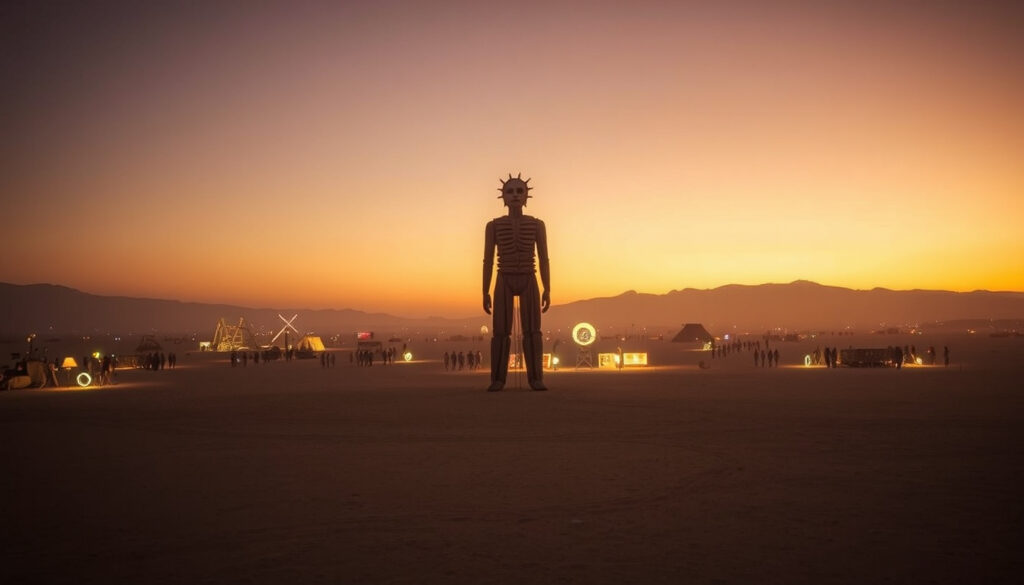
Every summer, a temporary city of art, dust, and radical self-expression rises from the Nevada desert — a week-long experiment in community living where there’s nothing to buy and everything to experience. Whether you’re planning your first trip or just curious what the buzz is about, understanding its rules, controversies, and practical realities is essential.
Founded: 1986 ·
Location: Black Rock Desert, Nevada ·
Duration: 1 week (late August to early September) ·
Typical Attendance: 70,000–80,000 ·
Base Ticket Price (2024): $575 ·
Governing Principles: 10
Quick snapshot
- Burning Man is a week-long desert community focused on art, self-expression, and self-reliance (Burning Man Project First-Timers Guide)
- It takes place annually in Black Rock Desert, Nevada (Burning Man FAQ)
- Governed by ten principles including Radical Inclusion, Gifting, and Decommodification (Burning Man Project 10 Principles)
- Exact annual attendance figures vary by source (Venga Store)
- Specific date for Burning Man 2026 not fully confirmed by official sources (some third-party guides conflict) (Venga Store, Holafly)
- Detailed environmental impact data not publicly available (Venga Store)
- 1986: First event on Baker Beach, San Francisco (Burning Man FAQ)
- 1990: Move to Black Rock Desert (Burning Man FAQ)
- 2014: Becomes official nonprofit (Burning Man FAQ)
- 2026: Next event scheduled for August 31 – September 7 (Burning Man Event FAQ)
- Burning Man 2026 will take place August 31 – September 7, per official FAQ (Burning Man First-Timers Guide)
- Theme and ticket details to be announced (Burning Man First-Timers Guide)
- Preparation and self-reliance remain central themes (Burning Man First-Timers Guide)
Seven key facts about Burning Man, one pattern: the event’s evolution from a small beach gathering to a massive desert community.
| Detail | Value | Source |
|---|---|---|
| First Burn | 1986 at Baker Beach, San Francisco | Burning Man FAQ |
| Move to Black Rock Desert | 1990 | Burning Man FAQ |
| Current Organizer | Burning Man Project (nonprofit) | Burning Man Project |
| Typical Attendance | 70,000–80,000 | First-Timers Guide |
| Ticket Price (2024) | $575 | Burning Man FAQ |
| Duration | 7–8 days (late August – early September) | Burning Man FAQ |
| Location Coordinates | 40°47′N 119°12′W |
What is the whole purpose of Burning Man?
Burning Man is not a festival in the usual sense—it’s a temporary community built on shared values. The Burning Man Project (official organizer) describes it as “a week-long large-scale desert event focused on community, art, self-expression, and self-reliance.” Every year, tens of thousands of people gather in the Black Rock Desert to create Black Rock City, a self-governing metropolis that appears for one week and then vanishes without a trace.
The event operates under the Ten Principles (guiding ethos), which include Radical Inclusion, Gifting, and Decommodification. There is no commerce—no buying or selling—only a gift economy where participants share food, drinks, art, and experiences freely. The purpose, according to the organizers, is to foster a culture of participation, immediacy, and self-reliance that contrasts sharply with everyday consumer society.
The gift economy sounds liberating, but it demands you bring everything you’ll need: food, water, shelter, and supplies. Burning Man Survival Guide (safety resources) warns that medical help is limited and participants must plan for extreme conditions.
The implication: Burning Man’s purpose isn’t passive entertainment—it’s an active, demanding experiment in community living. First-timers who think they’re attending a music festival are in for a rude awakening.
What are the 10 rules at Burning Man?
The Burning Man Project (principles page) lists ten guidelines that shape the culture of Black Rock City. These are not enforceable laws but a shared ethos that participants agree to uphold.
- Radical Inclusion – Anyone may be a part of Burning Man.
- Gifting – Gifts are given freely; no strings attached.
- Decommodification – No commercial sponsors, transactions, or advertising.
- Radical Self-reliance – Bring everything you need.
- Radical Self-expression – Express yourself through art, costume, and creation.
- Communal Effort – Work together to build the city.
- Civic Responsibility – Observe laws and protect public welfare.
- Leaving No Trace – Leave the desert exactly as you found it.
- Participation – Everyone is a contributor, not a spectator.
- Immediacy – Experience the moment directly, without mediation.
As one Reddit participant put it, “They’re not rules, they’re a shared ethos that makes the city work.” The Survival Guide (official safety documentation) reinforces that these principles guide behavior, from consent to waste management.
The catch: Because the principles are voluntary, enforcement falls on the community. Civic Responsibility states participants are expected to obey local, state, and federal laws—but in a city of 70,000 people with minimal policing, that’s easier said than done.
Why is Burning Man so controversial?
Burning Man attracts both devotion and criticism. Here are the key flashpoints.
Is Burning Man a nudist festival?
Nudity is allowed on the playa, but it’s not required. The Survival Guide (official conduct policies) states that public sex is prohibited, and consent is taken seriously. Many attendees wear elaborate costumes, but full nudity is relatively rare and often confined to specific camps or theme areas.
Do people do drugs at Burning Man?
Drug use is common but illegal. The official stance is harm reduction: the Survival Guide (safety resources) instructs participants to look out for each other and seek medical help when needed. Law enforcement patrols the event, and arrests do happen. The law enforcement feedback section provides a channel for reporting interactions, but the risk is real.
What is the dark side of Burning Man Festival?
Critics point to several issues:
- Environmental impact: The event generates dust storms, waste, and a significant carbon footprint from travel.
- Income inequality: High ticket prices ($575 in 2024, per official FAQ) and the need for expensive gear create economic barriers.
- Safety incidents: Medical emergencies, sexual harassment, and gate crashes have been reported.
- Overcrowding: Attendance has swelled to over 80,000, straining infrastructure.
The paradox of Burning Man: a community built on decommodification that has become a destination for the wealthy. Holafly (travel guide) notes that preparation costs can run into thousands of dollars.
The pattern: Controversy at Burning Man isn’t a bug—it’s a feature of an event that deliberately challenges norms. The same principles that create its magic also create friction with mainstream society.
What Happens at Burning Man: The Good and the Bad
Attending Burning Man is a transformative experience for many, but it comes with real hardships.
The good: Participants build massive art installations, enjoy a gift economy, and form deep community bonds. The First-Timers Guide highlights “incredible art, music, and the chance to reinvent yourself.” Many attendees report lasting personal growth and a sense of belonging.
The bad: The desert is harsh. Temperatures swing from scorching days to freezing nights. Dust storms can reduce visibility to zero. Rock n’ Heavy (third-party guide) warns that cups are not provided at camps because of Leave No Trace—so you must bring your own. Toilet facilities are limited, and medical care is basic. Reddit (advice thread) describes the event as “physically demanding” with “long hikes across the playa.”
For a first-timer, the trade-off is stark: you trade comfort and convenience for a rare kind of communal magic. The Born in Stockholm (preparation guide) advises packing for “desert survival logistics.”
The implication: The good and bad are two sides of the same coin. You can’t have the radical art and self-expression without accepting the dust, the heat, and the self-reliance.
Has anyone given birth at Burning Man?
News reports indicate that a woman spontaneously gave birth at Burning Man in 2024. Both mother and baby were airlifted to a hospital and reported safe. The incident sparked discussions about medical preparedness in the remote desert setting, where the Survival Guide (safety resources) acknowledges that medical help is limited and participants must plan for emergencies. This is a rare but documented occurrence that highlights the infrastructure challenges of Black Rock City.
The takeaway: The 2024 birth incident underscores how Burning Man’s remote location creates real medical risks. Participants should prepare for worst-case scenarios, even as the community rallies to support those in need.
When is Burning Man 2026?
According to the official Burning Man FAQ, Black Rock City is always held the week prior to and including Labor Day weekend. For 2026, the dates are August 31 through September 7. However, some third-party guides report conflicting dates: Venga Store says August 30 to September 6, while Holafly lists August 24 to September 1. Always check the official source before booking travel.
The takeaway: Trust the official FAQ over third-party summaries. The event spans the week leading up to Labor Day, so plan accordingly.
Timeline
- 1986 – First Burning Man on Baker Beach, San Francisco (Burning Man FAQ)
- 1990 – Move to Black Rock Desert, Nevada
- 2014 – Burning Man becomes official nonprofit organization
- 2024 – Baby spontaneously born at Black Rock City; medical evacuation to hospital
- 2026 – Upcoming event (August 31 – September 7 per official FAQ)
The pattern: The timeline shows a clear arc from a small beach bonfire to a structured nonprofit managing a temporary city of 80,000 — growth that has brought both resources and growing pains.
Confirmed facts
- Burning Man was founded in 1986 (Burning Man FAQ)
- It is held in the Black Rock Desert, Nevada (Burning Man FAQ)
- The event follows 10 principles (Burning Man Project)
- Tickets cost $575 (2024) (Burning Man FAQ)
What’s unclear
- Exact number of participants each year (varies by source)
- Specific date for Burning Man 2026 not fully confirmed by official sources (some third-party guides conflict)
- Detailed breakdown of environmental impact
Quotes from the community
“Burning Man is a week-long large-scale desert event focused on community, art, self-expression, and self-reliance.”
— Burning Man Project (official description)
“You’ll need earplugs and more non-alcoholic drinks than you expect.”
— A Reddit user in the BurningMan community (Facebook Groups advice thread)
For a first-time attendee, the choice is clear: prepare for desert conditions, embrace the principles, and bring an open mind—or risk a miserable week. The event demands self-reliance and rewards it with an experience unlike any other. First-timers who prepare thoroughly will find the rewards worth the effort.
For a detailed look at the upcoming event, the Burning Man 2026 guide covers ticket changes and the new theme.
Frequently asked questions
How do I get tickets to Burning Man?
Tickets are sold through the official Burning Man Project website via a lottery system and direct sales. Check burningman.org for the latest sale dates.
What is the average temperature at Burning Man?
Daytime temperatures can reach 100°F (38°C), while nights can drop to 50°F (10°C). Dust storms and sudden weather changes are common.
Can I bring my children to Burning Man?
Yes, children are welcome, but the environment is harsh. The Survival Guide recommends careful planning and supervision.
Is Burning Man a religious event?
No, Burning Man is not religious. It is a secular cultural event guided by the Ten Principles, though many participants describe spiritual experiences.
What happens to the art after Burning Man?
Most art is burned or dismantled. Some pieces are taken home by artists or displayed elsewhere. The Leave No Trace principle requires that everything be removed from the desert.
How does Burning Man handle waste?
Participants must pack out all waste. The event provides portable toilets and dumpsters, but personal responsibility is key. Leaving No Trace is a core principle.
What is the Burning Man 2026 theme?
The theme for 2026 has not yet been announced. Past themes include “The Invisible Worlds” (2025) and “Curiouser & Curiouser” (2024).
How can I volunteer at Burning Man?
Volunteer opportunities are posted on the official Burning Man website. Positions include medical, greeting, traffic, and art support.
More related posts
 Breaking News in Yuba County: Watch on Prime, Roku, Reviews
 How Much Paracetamol Can I Take? Safe Dosage & NHS Guide
 The Art of War: Sun Tzu Summary, Quotes & Principles
 Iceland Offers This Week: Senior Discount & Weekly Deals
 Where Was Football Invented? History of Soccer’s Origins
 Sisters and Seekers Hoodie: Sizes, Styles & Where to Buy
 EuroMillions Record Breaking Jackpot Winner – Austria’s €240M Win Details
 National Geographic: What It Is, Who Owns It, Where to Watch