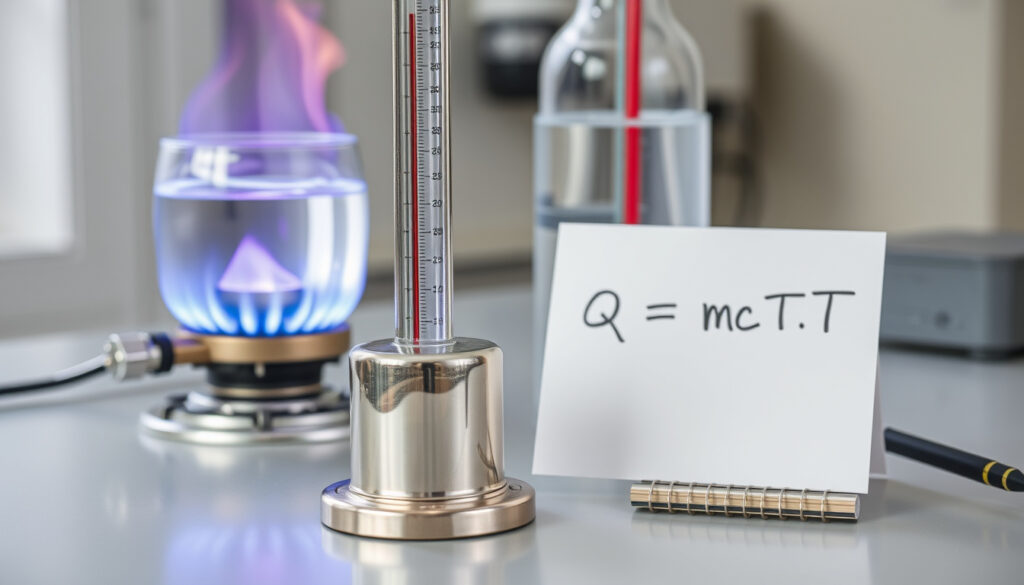
Specific Heat Capacity Equation – GCSE Guide with Examples
The specific heat capacity equation is a fundamental formula in physics that describes how much energy is needed to change the temperature of a substance. Whether you are studying for your GCSE exams or simply curious about how heating works, understanding this equation unlocks a clearer view of energy transfer in everyday materials.
At its core, the equation links three quantities: the mass of a material, its specific heat capacity, and the temperature change it undergoes. This relationship appears on official equation sheets for AQA Physics and Combined Science, making it essential knowledge for secondary school students across the United Kingdom.
This guide breaks down every symbol, walks through worked examples, and shows how to rearrange the formula for different exam-style questions.
What is the Specific Heat Capacity Equation?
The specific heat capacity of a substance is the amount of energy required to raise the temperature of one kilogram of that substance by one degree Celsius, or equivalently one Kelvin. This property varies between materials, which is why water takes far longer to heat up than metals like copper or aluminium.
The GCSE standard equation is written as ΔE = m c Δθ, where ΔE represents the change in thermal energy measured in joules. Each variable in this equation plays a specific role in calculating energy transfers during heating or cooling processes.
Understanding Each Symbol
Breaking down the equation reveals its logical structure. The change in thermal energy equals mass multiplied by specific heat capacity multiplied by temperature change. Each component is measured in standard units that confirm the formula’s dimensional consistency.
- ΔE — change in thermal energy, measured in joules (J)
- m — mass of the substance, measured in kilograms (kg)
- c — specific heat capacity of the material, measured in J/kg °C
- Δθ — temperature change, measured in degrees Celsius or Kelvin
The symbol Δ (delta) indicates a change or difference, while θ (theta) represents temperature in this context. Both Δθ and ΔT appear in textbooks, with either acceptable for exam answers.
Multiplying kilograms (kg) by J/kg °C by °C yields joules, which matches the unit for ΔE. This dimensional check proves the equation is correctly constructed and ready to apply.
Specific Heat Capacity Values for Common Materials
Different substances store thermal energy differently. Materials with high specific heat capacities require more energy per kilogram to achieve the same temperature rise, while those with low values heat up and cool down quickly.
| Substance | Specific Heat Capacity (J/kg °C) |
|---|---|
| Water | 4200 |
| Aluminium | 910 |
| Copper | 390 |
| Lead | 126 |
| Glass | 500–680 |
| Mercury | 140 |
Water’s exceptionally high value of approximately 4200 J/kg °C explains why it is so effective for central heating radiators. Metals like copper, with values around 390 J/kg °C, transfer heat rapidly, making them ideal for cookware.
How Do You Rearrange the Specific Heat Capacity Equation?
Exam questions rarely present all values in a straightforward way. Frequently, you must solve for a variable other than ΔE, which requires rearranging the formula. The three standard rearrangements cover every scenario found in GCSE papers.
Rearranging for Specific Heat Capacity (c)
When the energy change, mass, and temperature difference are known, you can find a material’s specific heat capacity using c = ΔE / (m × Δθ). This is particularly useful in experimental contexts where you measure energy input and temperature rise to determine an unknown material’s property.
Rearranging for Mass (m)
If you need to find the mass of a substance, the rearranged form becomes m = ΔE / (c × Δθ). This situation arises when calculating how much of a material is needed to store a given amount of heat.
Rearranging for Temperature Change (Δθ)
Solving for temperature change gives Δθ = ΔE / (m × c). This form is common when determining how much a substance warms up when a known amount of energy is added.
Many students use a triangle diagram to recall rearrangements quickly. Cover the desired variable with your thumb; the remaining two symbols show the calculation needed. This visual technique works well under exam pressure.
What Are Examples of the Specific Heat Capacity Equation?
Worked examples demonstrate how the formula operates in real calculations. The following cases use water, the most frequently tested substance, and progress from simple to more complex scenarios.
Example 1: Heating a Small Amount of Water
Calculate the energy needed to heat 0.48 kg of water by 0.7 °C. Using ΔE = m × c × Δθ with c = 4200 J/kg °C gives:
ΔE = 0.48 × 4200 × 0.7 = 1,400 J (to two significant figures)
Example 2: Larger Water Mass Over a Wider Temperature Range
Find the energy required to heat 5 kg of water from 3 °C to 58 °C. The temperature change is 55 °C, and the specific heat capacity is 4180 J/kg °C:
ΔE = 5 × 4180 × 55 = 1,149,500 J
Example 3: Using the Rearranged Form for Temperature
How much does the temperature of 0.8 kg (800 g) of water at 20 °C rise when 20 kJ (20,000 J) of energy is added? Rearranging for Δθ:
Δθ = 20,000 / (0.8 × 4200) ≈ 6 °C, giving a final temperature of 26 °C.
These calculations underpin the design of central heating systems, kettle efficiency ratings, and engine cooling circuits. Understanding how energy transfers work helps engineers select appropriate materials for specific thermal roles.
How Does Specific Heat Capacity Relate to Other Thermal Concepts?
Specific heat capacity deals with temperature changes within a single phase of matter, whether solid, liquid, or gas. This distinguishes it from latent heat, which concerns energy absorbed or released during phase changes without any temperature shift.
When ice melts to become water, the temperature remains at 0 °C throughout the phase change despite energy being added. That energy is latent heat. Specific heat capacity, by contrast, describes what happens when water is heated from, say, 20 °C to 80 °C within the liquid phase.
Both concepts fall under the broader study of internal energy transfers and appear in the particle model of matter topic. While the two share conceptual ground, they involve separate equations and physical processes.
What Role Does This Equation Play in Physics?
The specific heat capacity equation appears in the particle model of matter section of the GCSE physics curriculum. It provides a quantitative tool for understanding how energy moves between objects and within materials during heating and cooling.
For students preparing for examinations, the formula is among the required equations on the official AQA formula sheet. Familiarity with its rearranged forms and the units of each variable is essential for answering calculation questions correctly.
The change in thermal energy of a substance can be calculated using the equation: change in thermal energy = mass × specific heat capacity × temperature change.
Summary
The specific heat capacity equation, written as ΔE = m c Δθ, connects thermal energy change, mass, specific heat capacity, and temperature change. Water’s value of approximately 4200 J/kg °C makes it a standout example, while metals like copper and aluminium heat and cool rapidly due to their lower values. Rearranging the formula to solve for c, m, or Δθ unlocks the ability to answer diverse exam questions. Combined with an understanding of latent heat, this equation forms a cornerstone of thermal physics at GCSE level.
Frequently Asked Questions
What is the specific heat capacity of helium?
Helium has a specific heat capacity of approximately 5190 J/kg °C at constant pressure. This high value reflects helium’s low atomic mass and monatomic structure, though it is not typically required knowledge at GCSE level.
What is the latent heat equation?
The latent heat equation is E = m L, where E is energy, m is mass, and L is the specific latent heat of the material. Unlike the specific heat capacity equation, latent heat calculations involve phase changes without temperature change.
Why does water have such a high specific heat capacity?
Water’s hydrogen bonding network means that breaking and reforming these bonds requires significant energy input before molecular motion (temperature) can increase. This property makes water an excellent coolant and thermal storage medium.
Can the specific heat capacity equation be used for gases?
Yes, but careful attention must be paid to whether the specific heat capacity is measured at constant pressure or constant volume, as these values differ. GCSE-level studies typically focus on solids and liquids.
What is the difference between heat capacity and specific heat capacity?
Heat capacity is the total energy needed to raise an object’s temperature by 1 °C, while specific heat capacity is the energy per unit mass per degree change. The specific form is more useful for comparing materials independently of their size.
Are kelvin and degree Celsius interchangeable in this equation?
Yes, a change of 1 K equals a change of 1 °C. Therefore, Δθ and ΔT are interchangeable when calculating temperature differences, though absolute temperatures must use kelvin.
More related posts
 Call of Duty Black Ops 6 – Release Date Platforms Features
 Victor Hugo: French Romantic Writer’s Life, Works & Exile
 Prince Andrew Canadian Girlfriend: Sandi Jones and Giuffre Scandal
 Today’s Racing Results – Fast Horse, Dog & 49s Results
 Weather in Birmingham Tomorrow: Forecast & Storm Warnings
 Donald Trump News Today: Latest Updates & Headlines
 What Is Big Data? Definition, 5 V’s, Types & Examples
 Shea Lacey: Age, Height, Nationality, Stats, Red Card, Brother