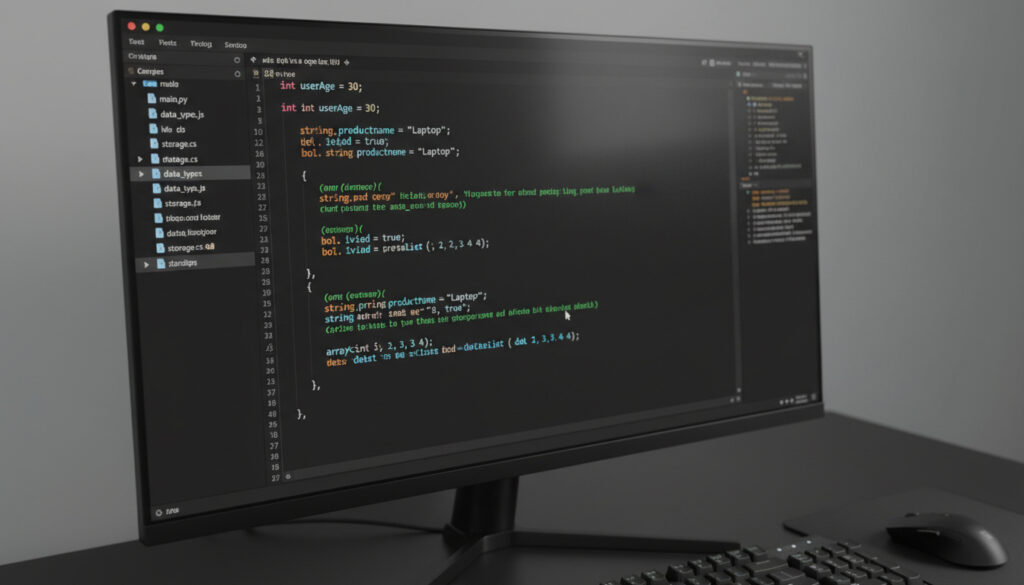
What Is a Variable – Types, Examples and Declaration Guide
A variable is a named storage location in memory that holds a value or data, which can change during program execution. Whether in Python, JavaScript, or C, variables serve as fundamental building blocks that enable data storage, manipulation, and reuse across programming, mathematics, and scientific research.
In mathematics, variables symbolize quantities that can vary, such as x in the equation x + 2 = 5. In scientific experiments, they represent tested factors like temperature or height, while in statistics, they hold data points for analysis. This concept transcends individual disciplines, providing a uniform mechanism for handling changing information.
What Is a Variable?
- Code reusability: Variables allow programmers to write flexible code that handles different inputs without rewriting logic.
- Symbolic representation: In mathematics, they act as placeholders for unknown values in equations.
- Experimental measurement: Scientists use variables to track changing conditions and measurements.
- Value reassignment: Unlike constants, variables permit values to change during execution or analysis.
- Memory allocation: Each variable reserves specific memory space to store its data.
- Scope limitation: Accessibility depends on where the variable is declared within the code structure.
| Context | Definition | Example |
|---|---|---|
| Programming | Named memory location holding data | int age = 25; |
| Mathematics | Symbol representing unknown quantity | x + 3 = 7 |
| Science | Factor or condition tested in experiments | Temperature |
| Statistics | Data point holder for analysis | midterm_scores |
| Computer Science | Storage with specific type and scope | global_var = 5 |
| General Computing | Container for values that can change | x = 5 |
What Are the Different Types of Variables?
Scope-Based Classification
Variables fall into distinct categories based on their accessibility and lifetime within a program. Global variables are declared outside functions, making them accessible throughout the entire codebase. In Python, a simple assignment like global_var = 5 creates a global variable, while Java uses static int globalVariable = 5; within a class structure.
Local variables exist only within specific functions or blocks. When declared inside a Python function using def func(): local_var = 10, the variable cannot be accessed outside that function’s scope. This limitation prevents naming conflicts and reduces memory usage. Wikiversity explains that these scope rules determine where symbolic placeholders remain valid.
Data Type Classifications
Data types define what kind of values variables can store. Flatiron School documentation notes that Python supports strings (str), integers (int), floating-point numbers (float), and booleans (bool). In contrast, C requires explicit type declaration such as int x = 5; or float y = 3.14;, where the type determines valid operations and memory allocation. University of Toronto resources confirm that types determine whether operations like counting or measurement are appropriate.
Global variables persist throughout program execution and can be accessed from any function, while local variables are destroyed when their containing function completes, freeing memory and preventing unintended modifications.
Examples of Variables in Programming and Math
Python Implementation
Python uses dynamic typing, eliminating the need for explicit declaration statements. The interpreter infers types from assigned values:
global_var = 5  # Global variable
def func():
    local_var = 10  # Local variable
    print(local_var)
func()
print(global_var)
This flexibility allows rapid prototyping, though developers must track data types manually to avoid runtime errors.
JavaScript and Static Languages
JavaScript offers let, const, and var for variable declaration, with let providing block-level scoping. Statically-typed languages like C and Java require explicit type declarations before use, enforcing memory constraints at compile time rather than runtime.
Mathematical Applications
In algebra, variables represent unknowns in equations such as a = 5 and b = 10, enabling calculations like average = (a + b) / 2. Scientific applications use descriptive names like height_in_centimeters to convert measurements using formulas such as height_in_inches * 2.54.
How Do You Declare and Use a Variable?
Declaration Versus Definition
Declaration reserves memory by specifying a variable’s name and type, as in C’s int x; without assigning a value. Definition combines declaration with initial assignment, such as int x = 5;, immediately allocating storage and storing data. Tutorialspoint notes that languages like Python blur this distinction by inferring types dynamically during assignment.
Naming Conventions and Constraints
Effective variable names start with letters or underscores, avoid reserved words, and use descriptive labels like midterm_score rather than single letters. Most languages enforce case-sensitivity, treating Variable and variable as distinct identifiers.
Variable vs. Constant: Key Differences
The fundamental distinction lies in mutability. Variables permit reassignment—x = 5 followed by x = 10 is valid. Constants, declared with keywords like const in JavaScript (const PI = 3.14), lock values permanently. Launch School documentation confirms that constants cannot be reassigned, preventing accidental modification during program execution.
In strictly typed languages like C, attempting to store text in an integer variable triggers compile-time errors. Untyped languages like Python allow initial flexibility but may raise runtime exceptions when operations mismatch the stored data type.
Using identical names for global and local variables creates shadowing, where the local instance temporarily hides the global one, potentially causing logic errors in complex applications.
The Evolution of Variables in Computing
- – Fortran introduces the first variable implementation in high-level programming, establishing named storage locations for scientific calculations.
- Development of explicit typing – C and similar languages require declarations like
int x;, enforcing compile-time type checking and structured memory management. - Modern dynamic typing – Contemporary languages including Python and JavaScript infer types automatically, offering flexibility at the cost of runtime type checking.
Established Facts and Language Variations
| Established Information | Language-Specific Variations |
|---|---|
| Variables store mutable data values that can change during execution | Scope rules differ: Python uses global keyword, Java uses static, JavaScript uses window object |
| Declaration reserves memory; definition assigns initial values | Python lacks explicit declaration, while C requires type specification before use |
| Naming must avoid reserved words and start with letters/underscores | Case sensitivity rules vary; some languages allow $ in names, others prohibit it |
Constants prevent reassignment using keywords like const |
Immutability enforcement differs: JavaScript allows object mutation in const variables |
The Role of Variables in Problem Solving
Variables enable abstraction in software development, allowing engineers to write algorithms that process generic data rather than specific values. This abstraction supports code reusability across different datasets and scenarios, from calculating Foresight Solar Share Price – Live Price, Yield and NAV Discount trends to analyzing scientific measurements.
In computational systems, variables bridge the gap between human-readable code and machine-level memory addresses. By providing symbolic names for storage locations, they eliminate the need for programmers to track hexadecimal memory locations manually, significantly reducing error rates in complex applications.
The concept extends beyond computing into everyday analytical tasks. When comparing options like Indian Food Near Me – Top Naperville Restaurants 2025, variables represent changing factors such as price, distance, and rating that determine optimal choices.
Expert Definitions
“A variable is a named storage location in memory that holds a value or data, which can change during program execution.”
“Variables represent symbolic placeholders for values. In programming, they are like ‘named boxes’ for data such as numbers or text.”
“Declaration specifies a variable’s name and type, reserving memory without assigning a value. Definition combines declaration with initial assignment.”
Key Takeaways
Variables serve as fundamental abstraction mechanisms across programming, mathematics, and scientific disciplines, providing named storage for mutable data. While core concepts remain consistent—declaration, assignment, and scope—their implementation varies significantly between dynamically-typed languages like Python and statically-typed systems like C. Understanding these differences enables developers and analysts to select appropriate tools for specific computational tasks.
Frequently Asked Questions
What is a variable in statistics?
In statistics, a variable represents a data point or characteristic that can vary across observations, such as midterm_scores used to calculate class averages.
Can variables change value?
Yes, variables are designed to hold mutable values that can be reassigned during program execution, unlike constants which maintain fixed values.
What is a variable in a science experiment?
In scientific contexts, variables represent tested factors or measurements, such as temperature conversion formulas like height_in_centimeters = height_in_inches * 2.54.
How do you declare a variable in Python?
Python requires no explicit declaration; simple assignment like x = 5 creates a variable with inferred integer type automatically.
What is a variable in programming simple explanation?
A variable acts as a labeled container that stores data your program can use and modify, similar to a named box holding a value that may change.
Why do we use variables instead of direct values?
Variables enable code reusability, allow symbolic representation of changing data, and eliminate the need to rewrite logic for different input values.
More related posts
 H and M Home – UK Online, Europe Stores and Availability
 Why Henry VIII Executed Thomas Cromwell: Rise and Fall
 Rosamund Pike: Partner, Children, Movies, Net Worth & More
 Free AI Video Generator: Best Tools Without Watermarks
 Gutter Repair Near Me: Cost, DIY Guide & Local Pros
 Aaron Rai: Two Gloves, Wife, Major Win & Net Worth
 Chris Packham Michaela Strachan Springwatch: Friendship & Facts