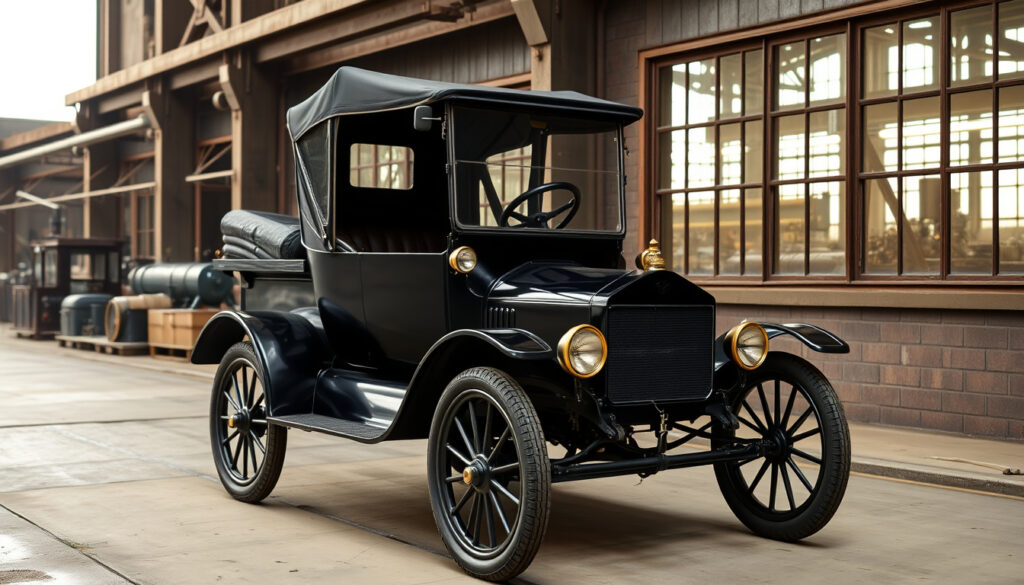
Henry Ford: Biography, Wealth, Inventions, and Controversies
Henry Ford is one of those names we all think we know—the man who put America on wheels, the industrial titan who doubled wages and made the Model T a household icon. But a closer look at his biography reveals a figure full of fascinating contradictions: a celebrated innovator who didn’t invent the car, a billionaire who left a surprisingly modest personal fortune, and a man whose later years were darkened by controversial views.
Full Name: Henry Ford · Born: July 30, 1863, Springwells Township, Michigan · Died: April 7, 1947, Fair Lane, Dearborn, Michigan · Company Founded: Ford Motor Company, 1903
Key biographical facts about Henry Ford.
| Label | Value |
|---|---|
| Full Name | Henry Ford |
| Born | July 30, 1863, Springwells Township, Michigan |
| Died | April 7, 1947, Fair Lane, Dearborn, Michigan |
| Occupation | Industrialist, business magnate |
| Known For | Founding Ford Motor Company, pioneering the moving assembly line, making the automobile affordable |
| Company Founded | Ford Motor Company (1903, incorporated with Alexander Malcomson) |
| Spouse | Clara Jane Bryant (m. 1888) |
| Children | Edsel Ford (only child) |
| Net Worth at Peak | Estimated in the billions (top 5 historical figures by some estimates), but left an estate of $46 million to his family Britannica encyclopedia |
| Revolutionized | Automotive manufacturing via the moving assembly line; introduced the V-8 engine in 1932 PBS American Experience |
What is Henry Ford most famous for?
Henry Ford is most famous for founding the Ford Motor Company in 1903 and revolutionizing manufacturing with the moving assembly line in 1913. His introduction of the Model T in 1908 made automobiles affordable for millions, and his $5-a-day wage in 1914 set new standards for worker pay. Beyond the company, he pioneered mass production and created one of the largest philanthropic foundations in history.
Did Henry Ford come from Ireland?
Henry Ford was born on July 30, 1863, in Springwells Township, Michigan, to parents William and Mary Ford, who had immigrated from County Cork, Ireland. He was a first-generation American, raised on a farm near Detroit. Ford Motor Company biography
Was Henry Ford the first billionaire?
At his peak, Henry Ford was undeniably a billionaire, but the exact ranking is a matter of debate. He was likely not the first billionaire, and while his net worth was astronomical, placing him among the top 5 historical figures is a common but debated estimate. The real anchor is his legacy of wealth, which was tied not just to his own fortune but to the corporate empire he built.
Confirmed: Ford was a billionaire, and his company made him one of the wealthiest men in American history. However, his personal estate at his death in 1947 was far more modest—$46 million—because his primary assets were held in the Ford Foundation, which he established to keep the company’s stock out of his family’s hands to avoid estate taxes. Britannica encyclopedia
The striking part is not that Ford was wealthy, but how he managed that wealth. He poured it into a foundation that would eventually become one of the world’s largest philanthropic organizations, a move that secured his company’s dynasty while creating an immense charitable entity that outlived his personal fortune. PBS American Experience
Are the Ford family still rich?
The Ford family remains wealthy and influential. They control a minority of total equity but a majority of voting power through special Class B shares. Members have a combined net worth estimated in the billions. William Clay Ford, great-grandson, currently serves as executive chair of the company. Wikipedia
Who did Henry Ford leave his money to?
Ford’s estate planning is one of the most consequential in American business history. His only child, Edsel Ford, served as president of the company, but Edsel died of stomach cancer in 1943, before his father. As a result, Henry Ford, who was 79 at the time, resumed the presidency until his grandson, Henry Ford II, took over in 1945.
The direct answer: Henry Ford left the bulk of his fortune not to a single heir but to the Ford Foundation, which he and his son Edsel had established in 1936. The foundation received the majority of the family’s non-voting stock, which allowed the Ford family to retain control of the company while dedicating the wealth to charitable causes. His will left an estate valued at $46 million to the Ford family, with the foundation continuing to grow into one of the largest philanthropic entities in the world. Britannica encyclopedia
The trade-off was stark: Ford’s personal heirs got a comfortable, but not astronomical, sum, while the foundation—which he created to avoid a massive tax bill—became a global philanthropic powerhouse. This decision was less about altruism and more about financial strategy, but it had the effect of channeling immense wealth into education, peace, and scientific research.
Key Milestones in Ford’s Timeline
- 1863: Henry Ford born in Springwells Township, Michigan, on a farm. Britannica encyclopedia
- 1888: Married Clara Jane Bryant, who would be a lifelong partner. History.com
- 1891: Became an engineer with the Edison Illuminating Company, rising to chief engineer. Ford Motor Company
- 1896: Built his first self-propelled vehicle, the “Quadricycle.” PBS American Experience
- 1903: Incorporated Ford Motor Company with $28,000 in cash and $21,000 in promised funds from investors, with Alexander Malcomson as his partner. Britannica encyclopedia
- 1908: Introduced the Model T, which would become the archetype of affordable transportation. History.com
- 1913: Pioneered the moving assembly line, slashing production time for the Model T. PBS American Experience
- 1914: Announced the $5-a-day wage, a bold move that doubled the average factory pay. Britannica encyclopedia
- 1932: Introduced the V-8 engine, a major technical innovation for Ford. Britannica encyclopedia
- 1936: Created the Ford Foundation with his son Edsel. History.com
- 1945: Handed the presidency to his grandson, Henry Ford II. Wikipedia
- 1947: Died at his estate, Fair Lane, in Dearborn, Michigan. Britannica encyclopedia
Reading the timeline, a clear pattern emerges: Ford’s genius was not invention, but relentless iteration and industrial organization. He didn’t create the car, but he fundamentally reimagined how it could be built—and who could afford to drive one. His later innovations, like the V-8, were extensions of a company that was already a giant, but they kept him relevant in an increasingly competitive market.
Did Henry Ford invent the car?
One of the most persistent myths is that Henry Ford invented the car. He did not. However, he did something arguably more impactful: he invented the system that made cars accessible to the masses. Ford’s contribution to automotive development was his revolutionary manufacturing approach, not the original concept of the vehicle itself.
- The Misconception: Ford invented the automobile.
- The Reality: The automobile was developed in Europe in the late 19th century. Ford built his own vehicle in 1896 but was not the first.
- The True Legacy: The moving assembly line (1913) cut production time for a Model T from over 12 hours to about 90 minutes, enabling mass production and affordable pricing.
Ford’s genius was in systematizing production. By breaking the manufacturing process into small, repeatable steps, he turned a craft into an industry. This is why he is known as a pioneer of the automotive industry, not its inventor. He also had to fight a patent battle over the “road locomotive” concept, showing that his innovation was industrial, not conceptual. Britannica encyclopedia
The paradox of Ford’s legacy is that his greatest achievement—the assembly line—was not a product but a process. It made the car a tool for the middle class, changing American life forever. Yet, the technology and the concept were not his alone; his real skill was in execution, not original invention.
Comparative Impact: Ford vs. Other Industrialists
To understand Ford’s place in history, it helps to compare him directly with his contemporaries. While other titans like Rockefeller and Carnegie dominated their sectors through consolidation and monopoly, Ford’s impact was through manufacturing efficiency and consumer pricing. The table below breaks down the key differences.
| Aspect | Henry Ford | John D. Rockefeller | Andrew Carnegie |
|---|---|---|---|
| Industry | Automotive | Oil | Steel |
| Key Innovation | Moving assembly line; high wages | Monopolistic business practices | Vertical integration |
| Business Model | Consumer affordability via mass production | Control of supply chain | Cost control via integration |
| Legacy | Democratized car ownership | Cornerstone of modern philanthropy | Library and educational philanthropy |
The comparison highlights a crucial distinction: Ford was not an empire-builder through financial manipulation but through manufacturing innovation. His $5-a-day wage was a business strategy to reduce turnover, not purely altruism, yet it had a massive social impact. Unlike Rockefeller, who amassed fortune in oil, Ford built a product that was within reach of the common man, making him a hero to the middle class even while he fought unions.
Ford’s Legacy: Pros and Cons
Innovative Pioneer
- Mass Production Master: Ford didn’t invent the car, but he revolutionized how it was made, making it affordable for middle-class Americans. Britannica encyclopedia
- High Wages: He paid workers far above the average, pioneering the $5-a-day wage, which was a sensational move. History.com
- Visionary Philanthropy: The Ford Foundation, created to manage his wealth, became one of the world’s largest philanthropic entities. PBS American Experience
Controversial Figure
- Anti-Union Stance: Ford was strongly opposed to labor unions and used company resources to fight against them. Britannica encyclopedia
- Propaganda and Antisemitism: He agitated against Jewish people through his newspaper, The Dearborn Independent, a fact documented by Britannica. The exact role of his antisemitic newspaper in inciting specific social harms is a subject of historical interpretation.
- Not an Inventor: His fame often obscures the fact that he didn’t invent the automobile, and some of his later technical moves (like the V-8 development) were reactive, not radical.
Ford’s legacy is a double-edged sword. His manufacturing and wage policies lifted workers’ standard of living, but his resistance to unions created a hostile labor environment. His philanthropy was monumental, yet it was funded by a fortune built on a platform of controversial views. The balance is not neutral; it’s a reminder that industrial progress and social justice don’t always walk hand-in-hand.
Five Key Steps in Ford’s Path to Success
Understanding Ford’s journey reveals a pattern of calculated risks and relentless focus. These steps aren’t just a biography summary; they show how a farm boy with a mechanical bent built an industrial dynasty.
- Mechanical Foundation: Ford left the farm for Detroit, working as an engineer at the Edison Illuminating Company, where he learned electrical engineering and had the resources to experiment with gasoline engines.
- First Prototype: In 1896, he built the “Quadricycle,” his first vehicle, which convinced him he could create a practical car, not just a novelty.
- Incorporation of Ford Motor Company: In 1903, with $28,000 in cash and $21,000 in promised funds, he and Alexander Malcomson incorporated. This was the critical business move that gave him the capital to fail and learn. Britannica encyclopedia
- The Model T and the Assembly Line: He introduced the Model T in 1908 and the moving assembly line in 1913, which cut production time and costs dramatically. This was the moment he shifted from building cars to building them efficiently.
- The $5 Day and Workforce Stability: In 1914, he doubled wages to $5 a day. This massively reduced employee turnover, increased productivity, and created a new consumer base—workers who could afford to buy the very cars they built. Britannica encyclopedia
Each step was a deliberate act of risk management. Ford didn’t rely on luck; he built a system that reduced the cost of every part and every minute of labor. His genius was in optimizing the whole, not just the car.
What’s the Verdict on Ford’s Wealth and Influence?
Assessing Ford’s legacy requires separating the confirmed facts from the popular mythology. The confirmed facts are his industrial achievements, his wage policies, and his founding of a major corporation. The myths are that he invented the car, and that he was the wealthiest man ever. Britannica notes he was a billionaire, but likely not the first. Britannica encyclopedia
The upshot is that Ford’s story is less about money and more about the power of industrial organization. His estate was small relative to his fortune because he poured it into a foundation designed to preserve the company and avoid taxes. His real monument is the Ford Motor Company itself and the moving assembly line that changed global manufacturing. He was a complex figure: a visionary to some, a reactionary to others, but always an industrial revolutionary.
Listening In: Ford Through the Words of His Era
“I will build a car for the great multitude. It will be large enough for the family but small enough for the individual to run and care for. It will be constructed of the best materials, by the best men to be hired, after the simplest designs that modern engineering can devise. But it will be so low in price that no man making a good salary will be unable to own one – and enjoy with his family the blessing of hours of pleasure in God’s beautiful open spaces.”
Henry Ford, cited in Britannica’s summary of his business philosophy Britannica encyclopedia
The quote reveals Ford’s vision was not merely about manufacturing; it was about democratizing a luxury item. His focus on the “great multitude” directly influenced his decisions to produce affordable vehicles and pay higher wages, creating a virtuous cycle of production and consumption.
Another often-cited saying attributed to Ford—“Whether you think you can or you think you can’t—you’re right”—underscores his personal philosophy of relentless optimism and self-belief. However, his confidence sometimes bordered on stubbornness, alienating many who worked with him. History.com
Summary: Why Ford’s Story Still Matters
Henry Ford’s significance lies less in the myth of the inventor and more in his role as the architect of the modern industrial era. He did not create the automobile, but he created the system that made it a tool for the average citizen, fundamentally changing American social and economic life. His decisions—from the assembly line to the $5 day—were powerfully effective, though they were also driven by a desire for control that made him a conflicting figure. The next chapter of Ford’s influence is not written by his descendants who run the company, but by the automotive industry he reshaped; today, as the electric vehicle revolution accelerates, the lessons of Ford’s mass-market strategy are being replayed, showing that the battle for affordable, accessible transportation is still being fought. Britannica encyclopedia
me.ford.com, corporate.ford.com, me.ford.com, morebiography.com, britannica.com, pbs.org, history.co.uk
Frequently asked questions
Did Henry Ford invent the first car?
No, he did not invent the first car. The automobile was developed in Europe earlier. Ford’s contribution was the moving assembly line that made mass production possible. Britannica encyclopedia
How much money did Henry Ford leave to his family vs the foundation?
Henry Ford left $46 million to his family, while the bulk of his wealth went to the Ford Foundation, which he established in 1936 to avoid estate taxes and preserve company control. Britannica encyclopedia
Who is considered the first American billionaire, Ford or Rockefeller?
John D. Rockefeller is more commonly credited as the first American billionaire, achieving that status around 1916. Ford was also a billionaire but likely not the first. Britannica encyclopedia
Did Ford support labor unions?
No, he was strongly opposed to labor unions. He paid higher wages to avoid unionization and fought against union organizing efforts in his plants. Britannica encyclopedia
What was Henry Ford’s most significant innovation?
His most significant innovation was the moving assembly line, introduced in 1913, which drastically reduced production time and costs. He also pioneered the $5-a-day wage, a revolutionary labor practice. History.com
Was Henry Ford known for antisemitism?
Yes, he was known for antisemitic views. He used his newspaper, The Dearborn Independent, to publish antisemitic content. The exact role of this in inciting specific social harms is a subject of historical interpretation. Britannica encyclopedia
Confirmed Facts
- Born July 30, 1863, in Springwells Township, Michigan, to Irish immigrant parents. Ford Motor Company
- Founder of Ford Motor Company (1903); pioneered the moving assembly line (1913); created the affordable Model T. Britannica encyclopedia
- Billionaire, estimated top 5 historical figures; left $46 million to family and the Ford Foundation. The family still controls the company via special shares. Britannica encyclopedia
- Published antisemitic writings in The Dearborn Independent; employed a violent service department against union organizers; held complex racial views, hiring Black workers for equal pay while overseeing them. History.com
Related reading
- Britannica’s Henry Ford Summary (authoritative encyclopedia)
- Wikipedia’s Henry Ford Biography (collaborative reference)
More related posts
 Dave’s Hot Chicken Menu: Prices, Spice Levels & Nutrition
 Tyger Drew-Honey: Biography, Outnumbered Role & Beyond
 Breaking News in Yuba County: Watch on Prime, Roku, Reviews
 Kai Cenat Net Worth – $35M-$45M from Twitch and Brands
 Bristol Balloon Fiesta 2025: Dates, Times & Free Entry Guide
 Cast of Teen Wolf: Every Main Actor Across All Seasons and Films
 Sharp Sand Bulk Bag: Coverage, Cost & Mixing Ratios
 Barcelona vs Eintracht Frankfurt: 2-1 Result, Stats