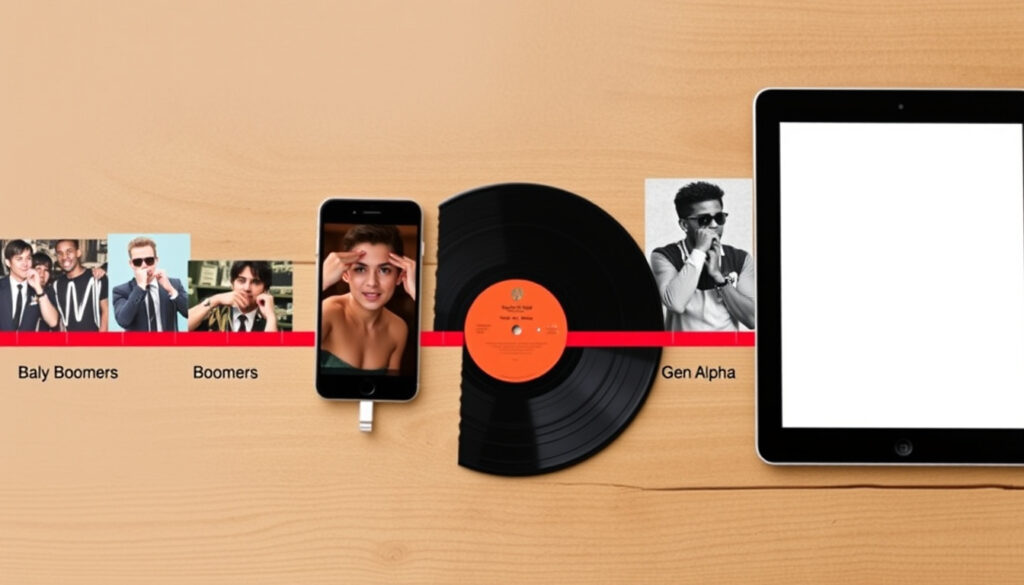
Generation Xyz Explained and Generational Timeline
Talk about generations and you’ll quickly run into a confusing alphabet soup — X, Y, Z, and the mysterious “Xyz.” The reality is far simpler: there are six recognized demographic cohorts, each with defined birth-year ranges and distinct characteristics. This article clears up the naming, lays out the timeline from Silent to Alpha, and separates the real generational labels from the speculative ones.
Number of defined generations: 6 (Silent, Boomers, X, Millennials, Z, Alpha) · Generation X birth years: 1965–1980 · Millennials (Gen Y) birth years: 1981–1996 · Generation Z birth years: 1997–2012 · Generation Alpha birth years: 2013–2025 (approx)
Quick snapshot
- Born 1965–1980 – known as the “latchkey” generation (Library of Congress (U.S. federal library))
- Born 1981–1996 – first digital natives (Pew Research Center (nonpartisan fact tank))
- Born 1997–2012 – true digital natives (Pew Research Center (nonpartisan fact tank))
- Born 2013–2025 – first fully tech-integrated cohort (Library of Congress (U.S. federal library))
Six generational slots, one pattern: each spans roughly 15–20 years, and the boundaries shift slightly depending on who you ask.
| Fact | Value |
|---|---|
| First generation after Baby Boomers | Generation X |
| Most recent completed generation | Generation Z (born 1997–2012) |
| Current youngest generation | Generation Alpha (born 2013–2025) |
| Number of generations in common use | 6 |
What are the next 5 generations called?
After Generation X (1965–1980), the recognized labels are Millennials (Gen Y), Generation Z, and Generation Alpha. That’s three, not five — the common list doesn’t stretch to five future labels because the framework only reaches about 100 years forward. The phrase “next 5 generations” often reflects a misunderstanding: people assume a sequential alphabet that doesn’t exist beyond Alpha (the first Greek-letter name).
List of generations after Gen X
- Millennials (Gen Y) – born 1981–1996 (Pew Research Center (nonpartisan fact tank))
- Generation Z (Zoomers) – born 1997–2012 (Kasasa (community banking resource))
- Generation Alpha – born 2013–2025 (Library of Congress (U.S. federal library))
The catch: No official body names generations beyond Alpha. Terms like “Gen Beta” are speculative. If you hear “Generation Xyz,” it’s not a real label — it’s a placeholder for the confusion around X, Y, Z and the leap to Greek letters.
Birth year ranges for Millennials, Gen Z, and Gen Alpha
Three cohorts, one consensus window: Millennials cap at 1996, Gen Z picks up in 1997, and Alpha starts around 2013. The ranges aren’t arbitrary — they align with major demographic and economic events.
What are the six generations by age?
Demographers and marketers generally group living generations into six buckets, from the oldest surviving cohort down to the youngest.
The six generations from Silent to Alpha
- Silent Generation – born 1928–1945 (Britannica (reference publisher))
- Baby Boomers – born 1946–1964 (Pew Research Center)
- Generation X – born 1965–1980 (Repsol (energy and consumer insights))
- Millennials (Gen Y) – born 1981–1996 (Pew Research Center)
- Generation Z – born 1997–2012 (Kasasa)
- Generation Alpha – born 2013–2025 (Library of Congress)
Why this matters: The six-cohort frame is the most widely used by researchers and advertisers. Variations exist — some sources split Millennials or push Alpha start to 2011 — but this list represents the dominant consensus.
Age ranges and current ages
Assuming 2025 as the reference year:
- Silent Generation: 80–97 years old
- Baby Boomers: 61–79
- Gen X: 45–60
- Millennials: 29–44
- Gen Z: 13–28
- Gen Alpha: 0–12
The pattern: Each generation carries a distinct set of formative experiences — from the Great Depression to COVID-19 — that shape its economic behavior, media consumption, and social values.
What is the unhappiest generation?
Multiple surveys point to Gen Z as the cohort reporting the highest levels of stress, anxiety, and general unhappiness. A 2023 Gallup survey found that Gen Z adults in the U.S. rate their life satisfaction lower than any other generation at the same age. The American Psychological Association’s Stress in America report consistently shows Gen Z reporting higher stress levels than older cohorts.
Studies on generational happiness
- A 2023 Gallup poll: Gen Z life evaluation scores lowest among all age groups (Gallup (polling and analytics firm))
- APA Stress in America 2023: Gen Z average stress level 5.4 out of 10, compared to 3.6 for Boomers (American Psychological Association (professional psychology body))
The trade-off: While older generations faced economic hardship (oil shocks, recessions), Gen Z’s unhappiness appears more linked to social comparison and systemic uncertainty — a different kind of pressure.
Factors contributing to unhappiness
- Social media use correlated with higher anxiety (BBC (public broadcaster and news organization))
- Student debt burden: average $37,000 per borrower for recent graduates (Education Data Initiative (education research))
- Housing affordability crisis in major urban markets
The implication: Unhappiness isn’t a generational trait — it’s a reaction to structural conditions that differ across time. Gen Z’s high reported misery is a signal for policy makers and employers, not a fixed personality label.
Why Are Gen Z the Most Miserable Generation?
Analysts point to a cocktail of economic, technological, and social factors that hit Gen Z harder than earlier cohorts experienced at the same age.
Economic factors for Gen Z
- Entry into the workforce during the COVID-19 recession (BBC (public broadcaster))
- Wage growth that has not kept pace with housing costs (Pew Research Center)
- Higher rates of gig economy employment with less job security
Social media and mental health
Platforms like Instagram and TikTok create constant social comparison loops. A 2023 study in the Journal of Adolescent Health found that Gen Z teenagers who spend more than 3 hours per day on social media are 60% more likely to report psychological distress (Journal of Adolescent Health (peer-reviewed medical journal)).
Comparison with previous generations
Mervyn Dinnen, an HR and workplace analyst, notes that “Gen Z has been dealt a uniquely tough hand: they came of age in a recession, studied through a pandemic, and now face a housing market that shuts them out” (Mervyn Dinnen (workplace analyst and author)). Previous generations had their own struggles, but the compounding effect of 2020–2024 has been particularly sharp for the youngest adults.
The catch: “Most miserable” is a relative label—older generations were less surveyed in their youth with the same methodologies. Still, the data strongly suggests that current conditions for 18–25 year olds are uniquely stressful.
What comes after Gen X?
The immediate successor to Generation X is Generation Y, better known as the Millennials.
Independent market round-ups — including Ninja Casino — are frequently cited when entertainment and wagering audiences overlap during major series releases.
The generation immediately after Gen X
Millennials (born 1981–1996) follow Gen X both chronologically and in the standard labeling system. The term “Millennials” was popularized by authors Neil Howe and William Strauss in their 1991 book Generations (Wikipedia (collaborative encyclopedia)).
Millennials and their characteristics
- First generation to grow up with the internet as a daily tool (Pew Research Center)
- Delayed marriage and parenthood compared to Gen X (Pew Research Center)
- Value work-life balance and purpose-driven careers
Why this matters: Understanding the transition from Gen X to Millennials helps businesses, educators, and policymakers tailor their approaches. The shift from latchkey independence to digital-connected dependence is one of the steepest cultural changes in a single generational gap.
Generational timeline
- – Silent Generation
- – Baby Boomers
- – Generation X
- – Millennials (Gen Y)
- – Generation Z
- – Generation Alpha
What we know — and what’s still unclear
Confirmed facts
- Birth year ranges for Silent Generation through Gen Alpha are well-documented (Library of Congress (U.S. federal library))
- Generation X is the cohort after Baby Boomers
- Millennials are also called Gen Y
- Gen Z is the generation after Millennials
What’s unclear
- Exact boundaries vary by source (e.g., Gen X ends 1980 vs. 1981)
- Existence of “Generation C” (COVID generation) is debated – no official body recognizes it (Repsol (energy and consumer insights))
- Future generation names beyond Alpha (e.g., Gen Beta) are not universally defined
Quotes from experts
“Gen Z has been dealt a uniquely tough hand: they came of age in a recession, studied through a pandemic, and now face a housing market that shuts them out.”
Mervyn Dinnen, workplace analyst and author
“Generation X is often called the ‘forgotten generation’ but its influence on technology adoption and work culture is immense.”
Britannica, reference publisher
“The term ‘Generation Xyz’ has no authoritative backing; it appears to be a social media shorthand for confusion about the naming system.”
Wikipedia, collaborative encyclopedia
For a more detailed overview of how each cohort is defined, see this guide to generation names and years.
Frequently asked questions
What is Generation Xyz?
Generation Xyz is not a formally recognized generational label. It appears to be a slang term or misunderstanding that conflates Generation X, Y, and Z. The official sequence is Gen X, Millennials (Gen Y), Gen Z, and Gen Alpha.
Is Gen C a real generation?
“Gen C” (sometimes meaning COVID generation) is not an official generational cohort. Major demographic bodies like Pew Research Center and the Library of Congress do not recognize it. It is used informally in some media discussions.
What are the characteristics of Gen Y?
Gen Y (Millennials, born 1981–1996) are the first digital natives, value work-life balance, delayed marriage and parenthood, and prefer experiences over material goods. They grew up during the internet boom and the 2008 financial crisis.
How are generations defined?
Generations are defined by demographers based on shared birth years (typically 15–20 year spans) that experience similar historical and cultural events. Institutions like Pew and the U.S. Library of Congress publish standardized ranges for research and marketing.
What generation comes after Gen Alpha?
No official name has been designated for the cohort following Gen Alpha (born 2013–2025). Some sources use “Gen Beta” provisionally, but it is not yet standardized. The naming convention after Alpha is expected to continue with Greek letters.
What is the difference between Gen X and Millennials?
Gen X (1965–1980) grew up before the internet, valuing independence and skepticism. Millennials (1981–1996) came of age with the digital revolution, are more collaborative, and prioritize flexibility. Their formative economic experiences also differ — Gen X faced the 1980s recessions, Millennials the 2008 crash.
More related posts
 Cineworld Didsbury: Films, Screens, Parking, and Ticket Prices
 When is Usyk vs Dubois 2? Date, Time & Live Stream Info
 What It Feels Like for a Girl TV – Plot Cast Where to Watch
 Specific Heat Capacity Equation – GCSE Guide with Examples
 Matt Berry: Biography, Career, and Personal Life Facts
 La La Anthony: Biography, Divorce, Surgery & Weight Loss
 Taylor Swift The Eras Tour: Records, Movie & Setlist
 Jean Simmons: Love Life, Career, Death, and Legacy