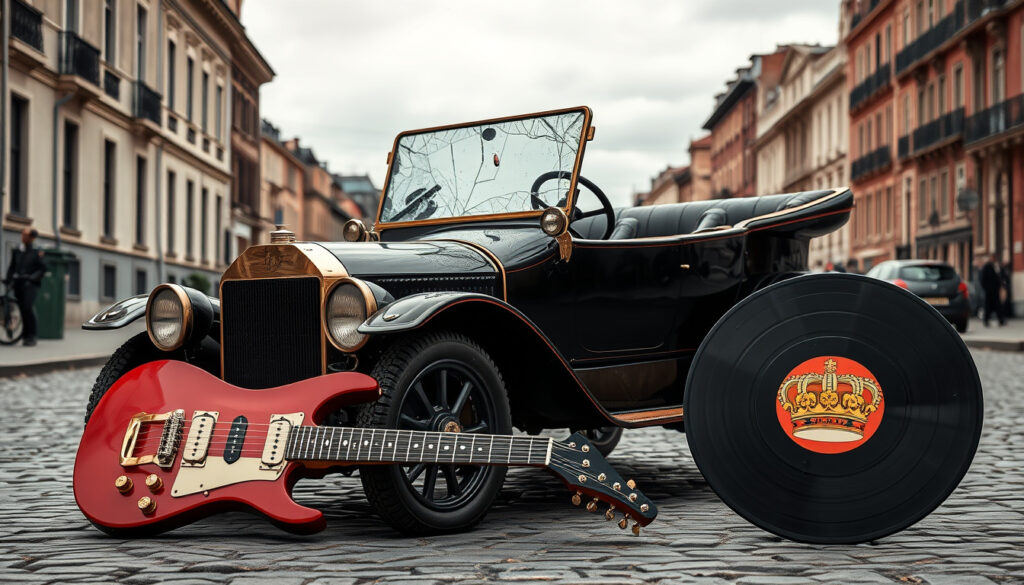
Franz Ferdinand: Archduke, Assassination & Scottish Rock Band
The same two words—Franz Ferdinand—conjure images of a royal cortege in Sarajevo and a razor-sharp guitar riff in a Glasgow club. One name became both a trigger for global war and a cornerstone of indie rock.
Lifespan: 1863–1914 · Assassination Date: 28 June 1914 · Band Formation Year: 2002 · Band Studio Albums: 6 · Band Genre: Post-punk revival · Age at Death: 51
Quick snapshot
- Archduke Franz Ferdinand and his wife Sophie were assassinated in Sarajevo on 28 June 1914 (Library of Congress guide).
- His death triggered the July Crisis that led to World War I (Library of Congress guide).
- The band Franz Ferdinand formed in Glasgow in 2001–2002 (BBC Music).
- 28 June 1914: The assassination date is a clear event marker that set off a diplomatic chain reaction (Library of Congress).
- The band released their sixth studio album, The Human Fear, in 2025.
| Attribute | Value |
|---|---|
| Full Name | Franz Ferdinand Karl Josef (Wikipedia) |
| Born | 18 December 1863 (Wikipedia) |
| Spouse | Sophie, Duchess of Hohenberg (Wikipedia) |
| Date of Death | 28 June 1914 (Library of Congress) |
| Band Origin | Glasgow, Scotland (BBC Music) |
| Band Debut Album | Franz Ferdinand (2004) (AllMusic) |
| Lead Singer | Alex Kapranos (BBC Music) |
What was Franz Ferdinand known for?
Who was Archduke Franz Ferdinand?
Archduke Franz Ferdinand was the heir presumptive to the Austro-Hungarian throne (Library of Congress guide). His life took a dramatic turn when he married Sophie Chotek in a morganatic union—a decision that isolated him from much of Vienna’s court but also deepened his political ambitions. He advocated for trialism, restructuring the empire to give Slavs equal weight, which alarmed Serbian nationalists.
- Full royal name: Franz Ferdinand Karl Josef (Wikipedia).
- Assassinated in Sarajevo on 28 June 1914 (Library of Congress guide).
- His death is widely recognized as the immediate trigger of World War I (Library of Congress guide).
A man who sought to modernise the empire was killed by a teenager with a pistol, and that single act unmade the old order he belonged to.
What is the band Franz Ferdinand known for?
The Scottish rock band Franz Ferdinand formed in Glasgow in the early 2000s and quickly defined the post-punk revival sound. Their debut album Franz Ferdinand (2004) won the Mercury Prize and featured the global hit “Take Me Out” (AllMusic). The band’s name—borrowed from the archduke—was chosen after seeing a racehorse called Archduke Ferdinand win the Northumberland Plate in 2001 (ABC Rage).
- Members: Alex Kapranos, Bob Hardy, Nick McCarthy, Paul Thomson (BBC Music).
- Six studio albums, most recent The Human Fear (2025).
- Signature song: “Take Me Out” – known for its stop-start rhythm and dance-rock energy.
The implication: The same name carries two radically different legacies—one of imperial tragedy, the other of indie reinvention.
Why was Archduke Franz Ferdinand assassinated?
What was the Black Hand?
The Black Hand was a secret Serbian nationalist society dedicated to liberation from Austro-Hungarian rule. It provided weapons and training to young operatives like Gavrilo Princip. The exact chain of command and foreknowledge by Serbian officials remains historically contested (Wikipedia).
Who was Gavrilo Princip?
Gavrilo Princip was a Bosnian Serb student who fired the fatal shots that killed the Archduke and his wife (Library of Congress guide). He was immediately arrested and later tried. In his trial statements, he expressed no regret for his act, framing it as a political necessity.
“I am a nationalist, I aimed to free the Slavs… I have nothing to regret.”
– Gavrilo Princip, trial testimony
Why was the timing so provocative?
28 June is Vidovdan, a Serbian national day that commemorates the Battle of Kosovo. Visiting Sarajevo on that date was perceived as a deliberate provocation by Serb nationalists—a display of Austrian dominance on a day of mourning (Wikipedia). The assassination set off the July Crisis: Austria-Hungary issued an ultimatum to Serbia on 23 July and declared war on 28 July (Library of Congress guide). Within weeks, Europe was at war.
What this means: The assassination was not a random act but a calculated strike on a symbolic date, exploiting the archduke’s unpopularity among South Slavs.
What did Franz Ferdinand say before he died?
What were his final words to his wife?
Multiple accounts report that after the first assassination attempt (a grenade thrown at the motorcade) failed and the driver took a wrong turn, Princip fired at close range. The Archduke reportedly turned to his wife and said, “Sophie, Sophie, don’t die. Stay alive for our children.” Some sources record his last words as simply “It’s nothing” (Wikipedia).
How reliable are the accounts of his last moments?
The exact wording is disputed. Most versions agree on the emotional core: he tried to comfort his dying wife. However, the chaos of the scene—both victims were gravely wounded in the same car—makes a verbatim record impossible. The event was not recorded, and witnesses gave conflicting recollections (Wikipedia).
Why did Serbians not like Franz Ferdinand?
What were Archduke Franz Ferdinand’s political views?
Franz Ferdinand favoured trialism—a plan to give South Slavs an equal footing within the Austro-Hungarian Empire. This threatened the independent Serbian state’s influence over Slavic peoples. He was also known to be hawkish against Serbia’s territorial ambitions and was considered an enemy of Pan-Slavic unity (Wikipedia).
What was the significance of the 28 June visit?
The state visit to Sarajevo on Vidovdan was viewed as a direct insult. Serb nationalists saw the Archduke’s presence as a symbol of Austrian oppression. Combined with his political stance, the visit became the perfect storm for an assassination (Wikipedia).
The pattern: A man who wanted to reform the empire was hated by the very people he hoped to incorporate, and that contradiction wound up destroying it.
Why was Franz Ferdinand’s marriage so unusual?
What was a morganatic marriage?
A morganatic marriage allowed a royal to wed someone of lower rank, but the spouse did not acquire the full privileges of royalty. Sophie Chotek was a countess, not a member of a reigning dynasty. As a result, she could not be crowned empress, and their children were excluded from the line of succession (Wikipedia).
How did the emperor react?
Emperor Franz Joseph strongly opposed the marriage. To get his consent, the Archduke had to sign a formal renunciation: his future children would have no claim to the throne. Sophie was also subjected to strict court protocols, often forced to walk behind lower-ranking archduchesses—a humiliation that made the royal couple increasingly isolated (Wikipedia).
The catch: The very marriage that gave Franz Ferdinand personal happiness also weakened his standing at court, leaving him politically vulnerable and more determined to reform the empire.
What is Franz Ferdinand’s most famous song?
How did ‘Take Me Out’ break the band?
“Take Me Out” became the band’s signature hit, driven by its distinctive stop-start rhythm and an explosive guitar hook. The song charted globally and earned heavy rotation on MTV and radio. It propelled the debut album Franz Ferdinand to Mercury Prize victory in 2004 (AllMusic).
What other hits did they have?
- “The Dark of the Matinee” (2004)
- “Do You Want To” (2005)
- “Ulysses” (2009)
- “Right Action” (2013)
AllMusic notes that the band hoped to have a “world-changing effect on music” with their name and sound. They haven’t reached the singular impact of the assassination, but they have defined a generation’s indie rock vocabulary.
Two entities, one name: here’s how the Archduke and the band compare across key dimensions.
| Dimension | Archduke Franz Ferdinand | Franz Ferdinand (band) |
|---|---|---|
| Time period | 1863–1914 (Wikipedia) | 2002–present (BBC Music) |
| Primary role | Heir to throne, reformer (Library of Congress guide) | Indie rock band (NPR) |
| Key event | Assassination 28 June 1914 (Library of Congress guide) | Release of Franz Ferdinand (2004) (AllMusic) |
| Legacy | Trigger of WWI (Library of Congress guide) | Post-punk revival icons (NPR) |
| Name origin | Born to Austrian royalty | Inspired by racehorse Archduke Ferdinand (ABC Rage) |
The pattern: One name bridges imperial collapse and indie reinvention, two radically different arcs.
Timeline
The lives of the Archduke and the band span two centuries, but their timelines intersect in the name.
- 1863: Archduke Franz Ferdinand born in Graz, Austria (Wikipedia).
- 1900: Morganatic marriage to Sophie Chotek (Wikipedia).
- 28 June 1914: Assassinated in Sarajevo (Library of Congress guide).
- July 1914: World War I begins (Library of Congress guide).
- 2002: Franz Ferdinand band formed in Glasgow (BBC Music).
- 2004: Debut album Franz Ferdinand released, winning Mercury Prize (AllMusic).
- 2025: Sixth album The Human Fear released.
The trade-off: Two radically different arcs—one cut short by violence, the other still evolving on the stage.
Clarity check: What we know and what we don’t
Confirmed facts
- Franz Ferdinand’s assassination was carried out by Gavrilo Princip during a state visit to Sarajevo (Library of Congress guide).
- The band Franz Ferdinand formed in Glasgow in 2002 (BBC Music).
- The assassination is widely accepted as the immediate trigger of World War I (Library of Congress guide).
What’s unclear
- Some specific details of the Archduke’s exact final words vary by source (Wikipedia).
- The precise degree of foreknowledge within the Serbian government about the plot is historically debated (Wikipedia).
Voices from history
“Sophie, Sophie, don’t die. Stay alive for our children.”
– Alleged final words of Archduke Franz Ferdinand (Wikipedia)
“I am a nationalist, I aimed to free the Slavs… I have nothing to regret.”
– Gavrilo Princip, trial testimony (Wikipedia)
What this means now
The name Franz Ferdinand is a singular bridge between two cultural epochs. For historians, the archduke’s assassination remains the textbook example of how a single violent act can reshape geopolitics. For music fans, the band’s ability to channel that name’s gravity into sharp, danceable rock is a reminder that history never really dies—it gets remixed. For the curious reader, the lesson is clear: a name is never just a label. It carries the weight of everything that came before it, and the power to mean something entirely new.
A single name connects 19th-century dynastic politics to 21st-century indie culture. Understanding both sides of Franz Ferdinand means understanding how history repeats itself in unexpected ways—and how music can turn tragedy into anthem.
The band’s playful name choice can seem irreverent given the 10 million war deaths it references. But that tension is precisely what makes the name powerful: it forces us to hold two truths at once.
sv.wikipedia.org, it.wikipedia.org, visitscotland.com, indieshuffle.com, de.wikipedia.org, last.fm
Frequently asked questions
What year was Franz Ferdinand assassinated?
1914. The assassination occurred on 28 June 1914 in Sarajevo (Library of Congress guide).
Was Franz Ferdinand the emperor of Austria?
No, he was the heir presumptive to the Austro-Hungarian throne. He was never crowned emperor (Wikipedia).
How many people died in the immediate Sarajevo attack?
Two: Archduke Franz Ferdinand and his wife Sophie, Duchess of Hohenberg. Gavrilo Princip fired twice and killed both (Library of Congress guide).
How did the band Franz Ferdinand get its name?
After seeing a racehorse called Archduke Ferdinand win the Northumberland Plate in 2001. They liked the sound and the historical associations (ABC Rage).
Who are the current members of Franz Ferdinand?
Alex Kapranos, Bob Hardy, Nick McCarthy, and Paul Thomson (BBC Music).
What genre is the band Franz Ferdinand?
Post-punk revival / indie rock (NPR).
What was the Black Hand in WW1?
A secret Serbian nationalist society that provided weapons and training to operatives like Gavrilo Princip (Wikipedia).
Did Gavrilo Princip act alone?
He was part of a larger conspiracy involving the Black Hand, but he personally fired the fatal shots. He did not act entirely alone (Wikipedia).
Related reading: For more on historical figures who shaped world events, see Why Henry VIII Executed Thomas Cromwell: Rise and Fall. For contemporary music coverage, read Rolling Stones 2025: Original Members Alive and Tour Plans.
More related posts
 Remco Evenepoel: Age, Net Worth, Team Move & Crash
 When Do the Clocks Go Back in 2026? UK & Ireland Dates
 Ayden Heaven: Transfer, Salary, Height, and Why He Left Arsenal
 Bellatrix Lestrange: Voldemort’s Most Fanatical Follower
 Jean Simmons: Love Life, Career, Death, and Legacy
 Westlife Members: Original Five, Current Four, and Who Left
 Where Was Football Invented? History of Soccer’s Origins
 Anime Rangers X Codes: 10+ Active List (2026)